
Etosha for First-Timers: Everything You Need to Know
Etosha National Park is one of Namibia's great wildlife destinations — and one of the easiest major African safari parks to explore yourself. If you're visiting for the first time, here's what to know before you go.
For many visitors, Etosha is the place where Namibia suddenly becomes the Africa they imagined before arriving.
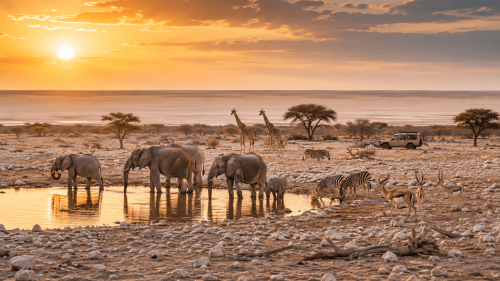
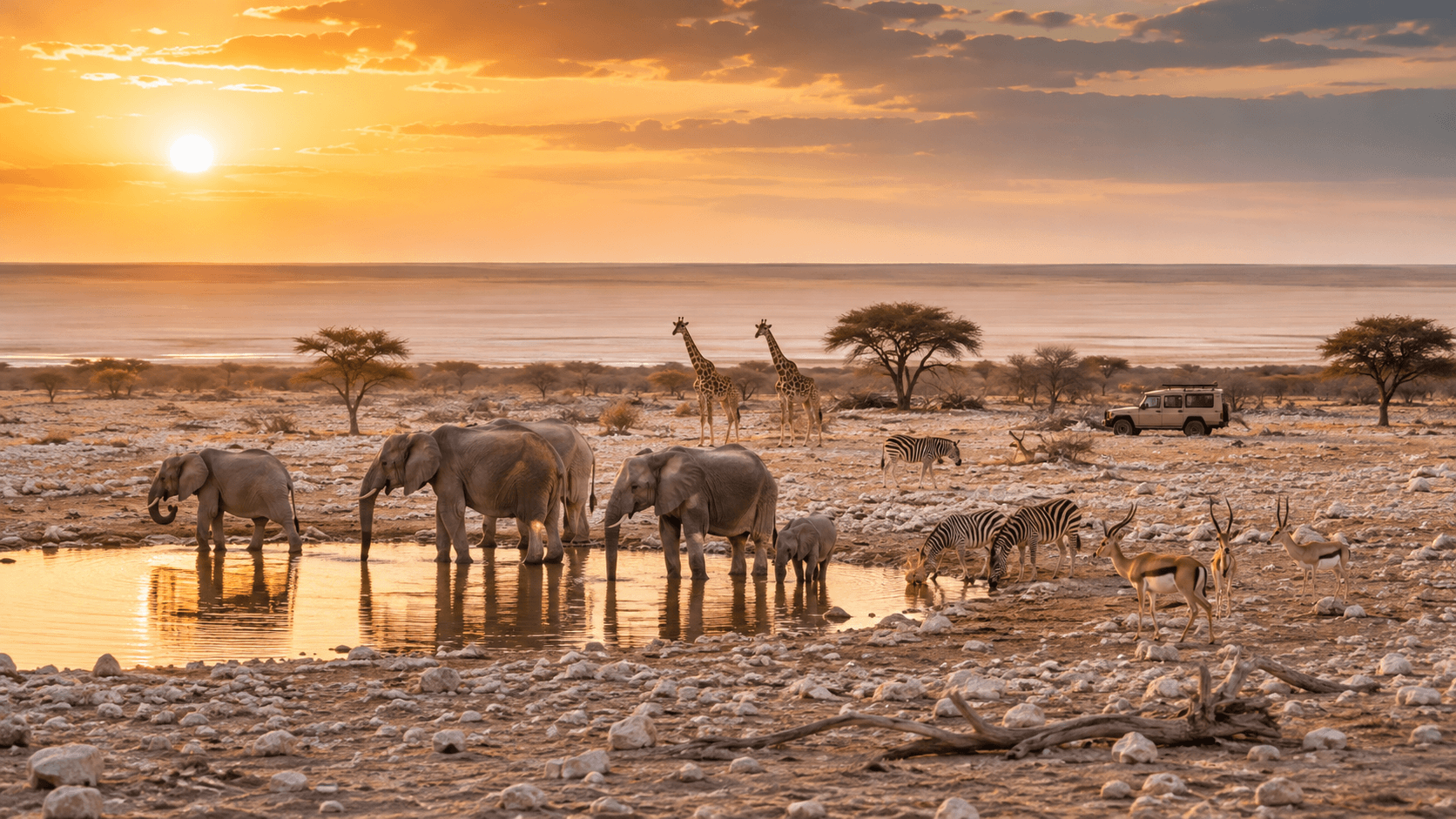
Elephants gather around dusty waterholes. Lions sleep beneath thorn trees. Giraffes cross open plains. Herds of zebra, springbok and wildebeest stretch across the horizon, while rhino may appear at a floodlit waterhole after dark.
At the centre of it all is the enormous Etosha Pan — a vast, pale salt pan that gives the park its distinctive landscape.
But one of Etosha's greatest advantages is that you don't necessarily need an expensive guided safari to experience it.
Etosha is an exceptionally good self-drive destination.
You can enter in your own vehicle, follow the park's roads from waterhole to waterhole and spend as much time as you like watching the wildlife you find along the way.
If you're planning your first Etosha trip, here's what you need to know.
What exactly is Etosha National Park?
Etosha National Park is Namibia's flagship wildlife park and one of the country's most important tourist destinations.
According to Namibia's Ministry of Environment and Tourism, the park covers approximately 22,935 square kilometres.
It is home to around 114 mammal species and more than 400 recorded bird species.
Wildlife includes:
- Elephant
- Black and white rhino
- Lion
- Leopard
- Cheetah
- Giraffe
- Zebra
- Blue wildebeest
- Springbok
- Oryx
- Eland
- Black-faced impala
- Damara dik-dik
- Hyena and jackal
Etosha is home to four of the traditional Big Five — elephant, lion, leopard and rhino. You will not find Cape buffalo roaming Etosha.
The Etosha Pan is what makes the park different
Etosha doesn't look like the lush safari landscapes many first-time visitors imagine.
Much of the park is dry, flat and extraordinarily open.
Its defining feature is the enormous Etosha Pan, the remains of an ancient lake system.
For much of the year the pan appears as an almost endless white expanse of salt, clay and mineral deposits.
The name Etosha is derived from an Oshindonga word associated with the idea of a place where plants do not grow.
During years with sufficient rainfall, however, water can enter sections of the pan and transform the landscape.
This can attract large numbers of waterbirds, including flamingos and pelicans.
The contrast between the enormous white pan, surrounding grasslands and concentrations of wildlife around permanent waterholes gives Etosha its particular character.
When is the best time to visit Etosha?
Etosha is open throughout the year, but the experience changes considerably between seasons.
The Namibia Tourism Board identifies roughly May to October as the prime period for game viewing.
May to October: Best for classic wildlife viewing
This is Namibia's cooler and drier period.
As natural surface water disappears, animals increasingly concentrate around Etosha's permanent and artificial waterholes.
Instead of driving endlessly looking for animals, you can often simply park at a productive waterhole and wait.
Something eventually arrives.
Sometimes it is a herd of zebra.
Sometimes twenty elephants.
Occasionally, it is a lion.
This concentration of wildlife around water is one of the reasons Etosha can offer such rewarding game viewing.
November to April: Green season
The rainy season offers a very different Etosha.
The landscape becomes greener, animals become less dependent on the permanent waterholes and wildlife can spread more widely across the park.
That can make some species harder to locate.
On the other hand, the green season brings dramatic skies, newborn animals and excellent birding.
When conditions are suitable, Fischer's Pan and parts of the wider Etosha system can attract flamingos and other waterbirds.
So the rainy season isn't necessarily the "bad" time to visit Etosha.
It is simply a different experience.
How many days do you need in Etosha?
For a first visit, three nights is a very good starting point.
Two nights is possible, but it can feel rushed.
Four or five nights gives you considerably more time to explore without feeling that every day is a race between camps.
A good first-time itinerary is to enter through Andersson Gate in the south, spend time around Okaukuejo, move east towards Halali, and eventually continue towards Namutoni and Von Lindequist Gate.
This allows you to see several different parts of the park rather than driving the same route every day.
Which entrance should you use?
Etosha has several major access gates.
Andersson Gate
Best for: Visitors arriving from Windhoek, Outjo or southern Namibia.
Andersson Gate is the most commonly used southern entrance and leads towards Okaukuejo.
Okaukuejo itself lies about 17 kilometres from the southern entrance, according to Namibia Wildlife Resorts.
For many first-time visitors, this is the obvious place to enter.
Von Lindequist Gate
Best for: Visitors approaching from Tsumeb and eastern Namibia.
This gate provides access to the Namutoni side of the park and is particularly useful if you intend to travel through Etosha from east to west or continue towards Namibia's north-east.
King Nehale Gate
Best for: Visitors approaching from northern Namibia.
King Nehale Lya Mpingana Gate provides direct access from the north and is useful for travellers combining Etosha with Oshana, Oshikoto, Ohangwena or Omusati.
Galton Gate
Best for: Visitors approaching western Etosha and the Kunene region.
Galton Gate provides access to the western side of Etosha and can be incorporated into itineraries involving Damaraland and north-western Namibia.
The Namibia Tourism Board lists Andersson, Von Lindequist, Galton and King Nehale among Etosha's principal access points.
Can you drive through Etosha yourself?
Absolutely.
In fact, self-driving is one of the best things about Etosha.
Namibia Tourism Board's self-drive guidance notes that Etosha is one of Namibia's major attractions that can generally be reached in a 2WD vehicle using paved and gravel roads.
A 4x4 can provide additional ground clearance and comfort, but you do not ordinarily need a serious off-road vehicle simply to visit Etosha's standard tourist routes.
This is not a place where visitors are expected to drive through deep sand or cross rivers.
You follow designated park roads.
Road conditions can nevertheless vary, particularly on gravel sections.
Don't plan your Etosha drive like a normal road trip
This is probably one of the most useful pieces of advice for first-time visitors.
A distance of 100 kilometres inside Etosha is not the same as driving 100 kilometres along the B1.
You are not there to cover distance quickly.
You will stop.
Constantly.
A giraffe appears beside the road.
Then you spend twenty minutes watching elephants.
Then someone tells you lions were seen at the next waterhole.
Then a herd of zebra blocks the road.
Suddenly, a journey that looks short on the map has consumed half the day.
In Etosha, the journey between two camps is the activity — not dead time between activities.
How game viewing in Etosha actually works
First-time safari visitors often imagine driving around until they happen to find a lion beside the road.
That certainly happens.
But Etosha's waterholes make wildlife viewing considerably more strategic.
Your park map will show the network of waterholes accessible from the tourist roads.
Drive to one.
Stop.
Switch off the engine.
Look around.
And wait.
A waterhole that looks completely empty when you arrive can look very different fifteen minutes later.
During the dry season, elephants, giraffes, zebra, wildebeest, springbok and predators all have to drink eventually.
Patience is often more productive than racing from one waterhole to another.
Don't ignore the "boring" animals
Everyone wants to see a lion.
And a rhino.
And a leopard.
That sometimes causes first-time visitors to drive straight past everything else.
Don't.
Stop for the giraffes.
Watch the jackals.
Look at the enormous herds of zebra and springbok.
Watch how different species behave around a waterhole when elephants arrive.
The best Etosha experiences aren't always rare sightings.
Sometimes they are simply twenty minutes spent watching ordinary wildlife doing something interesting.
Where should you stay inside Etosha?
Namibia Wildlife Resorts currently operates five resorts and one camp associated with Etosha:
- Okaukuejo Resort
- Halali Resort
- Namutoni Resort
- Dolomite Resort
- Onkoshi Resort
- Olifantsrus Campsite
Okaukuejo
If you only know one Etosha camp, it is probably Okaukuejo.
Its greatest attraction is its famous floodlit waterhole.
Guests can sit beside the waterhole after sunset and wait for animals to arrive.
NWR notes that elephant, lion and black rhino are among the species regularly observed there.
Okaukuejo also has accommodation, camping, a restaurant, shop, swimming pool, filling station and guided game drives.
Halali
Halali is located roughly in the central part of the main tourist area, making it extremely useful for breaking up a trip across Etosha.
It also has a floodlit waterhole and is surrounded by denser mopane vegetation.
NWR says the area is known for sightings of rhino, elephant and leopard.
Halali offers rooms, chalets, camping, a pool, shop, filling station and guided drives.
Namutoni
Namutoni provides a good base for exploring eastern Etosha.
It is also historically distinctive because of the old Namutoni fort.
If you're travelling across the park from west to east, Namutoni makes a logical final overnight stop before leaving through Von Lindequist Gate.
Should you stay inside or outside the park?
Both approaches work.
Staying inside Etosha
The major advantage is location.
You are already inside the park when the day's driving begins, and camps such as Okaukuejo and Halali offer floodlit waterholes you can watch after normal self-driving hours have ended.
That can be a major advantage.
Staying outside Etosha
There is a large selection of private lodges, guest farms and campsites around the major gates.
These can offer more varied accommodation, dining and service levels than the government-run camps.
The trade-off is that you need to travel to the gate before beginning your day's game viewing and leave again before the park closes.
For a first visit, a combination can work particularly well.
What time do the gates open and close?
Namibia Wildlife Resorts states that national park gates generally open at sunrise and close at sunset.
This means gate times change through the year rather than remaining fixed at one clock time.
Confirm the day's gate-closing time when you enter or when checking in at your camp.
Do not leave yourself with a long drive back to camp shortly before closing.
Wildlife, road conditions and other vehicles can easily delay you.
You can find NWR's current conditions and booking rules on its Terms and Conditions page.
Can you get out of the car?
Not wherever you want.
This is a national park containing lions, elephants, rhinos, leopards and other wild animals.
Visitors are expected to remain inside their vehicles except at designated locations where getting out is permitted.
You should also remain on marked tourist roads and obey all park signage and speed restrictions.
Getting out because you want a better photograph of an elephant is not brave.
It is dangerous, and it can result in action by park officials.
Self-drive or guided game drive?
You do not have to choose only one.
A particularly good first-time strategy is:
- self-drive during the day; and
- book at least one guided drive through your camp.
The self-drive gives you freedom.
If you find a lion and want to sit there for an hour, you can.
A guided drive gives you an experienced guide who understands animal behaviour, tracks and recent sightings.
Most importantly, official guided night drives allow you to experience the park after ordinary self-drive visitors have returned to camp.
NWR currently offers guided morning, afternoon and night drives from camps including Okaukuejo and Halali.
What does it cost to enter Etosha?
Park fees are charged separately from accommodation.
The Ministry of Environment and Tourism's currently published Park Entrance and Conservation Fee schedule lists Etosha together with Namibia's higher-tier national parks.
The published schedule lists the following combined entrance and conservation fees:
- Namibian adult: N$50 per day
- SADC adult: N$100 per day
- Other foreign adult: N$150 per day
- Vehicle with 10 seats or fewer: N$50 per day
The schedule states that fees apply per 24-hour period and that visitors and vehicles are charged for each applicable day.
How much does accommodation cost?
Accommodation varies considerably depending on the camp, room type and season.
As an example, NWR's published rates for July to October 2026 show Okaukuejo standard rooms starting at around N$2,380 per person sharing, while campsites are listed at N$560 per person.
Halali's corresponding 2026 rates start lower, with standard double rooms listed from around N$1,690 per person sharing and camping from N$550 per person.
Rates change seasonally, so use the current pages for Okaukuejo, Halali and the other NWR resorts before budgeting.
Book accommodation early
This matters particularly during Namibia's peak dry-season tourism period.
Etosha is not an obscure destination.
It is one of Namibia's most popular attractions, and desirable accommodation — particularly at Okaukuejo — can fill well ahead of arrival.
If you already know you want to stay inside the park, booking your accommodation should be one of the first things you organise.
NWR currently notes on its website that its normal online booking system may be unavailable at times and directs booking enquiries to its reservations team, so check NWR's website for the current booking method.
A simple three-day Etosha itinerary
Day 1: Andersson Gate and Okaukuejo
Enter through Andersson Gate as early as practical.
Check in or confirm your arrangements at Okaukuejo and spend the day exploring nearby waterholes.
Return to Okaukuejo before sunset.
After dinner, take something warm to wear and spend time at the floodlit waterhole.
Don't give up after ten minutes.
The entire point is to wait.
Day 2: Okaukuejo to Halali
Leave early and slowly work your way east.
Visit waterholes rather than simply taking the most direct road to Halali.
Stop frequently and allow the journey to consume most of the day.
Spend the night at Halali and visit its floodlit waterhole after dark.
Day 3: Halali towards Namutoni
Explore the eastern side of the park, including waterholes along the edge of the pan.
Stay at Namutoni or exit through Von Lindequist Gate depending on the rest of your itinerary.
If you have another day available, use it.
Etosha rewards travellers who aren't in a hurry.
What should you bring?
- Binoculars — arguably more useful than a huge camera lens for most visitors.
- Plenty of drinking water — especially during warmer months.
- Snacks — wildlife rarely appears according to your lunch schedule.
- A good park map — ideally one showing the waterholes.
- Camera and spare batteries.
- Phone charger or power bank.
- Sunglasses and sunscreen.
- Warm clothing — winter mornings and open-vehicle night drives can be surprisingly cold.
- A hat.
- Tyre-pressure gauge and basic vehicle equipment if self-driving.
Mobile coverage can be limited in parts of the park, so it is also sensible to have offline maps and information available before entering.
Fuel up when you can
Etosha is large.
Camps such as Okaukuejo and Halali list filling stations among their facilities, but don't build an itinerary around the assumption that fuel will always be available exactly when you need it.
Supplies can be interrupted anywhere in a remote part of Namibia.
A simple rule works well:
If you're in Etosha and have a convenient opportunity to fill the vehicle, fill it.
Don't expect restaurant service everywhere, all day
The major NWR camps have restaurants, shops or kiosks, but you are still travelling through a large national park.
Carry water and some food in the vehicle rather than assuming you'll encounter a café whenever you become hungry.
This is particularly useful when you find an exceptional wildlife sighting at lunchtime.
You don't want to leave twenty elephants because you forgot to pack a sandwich.
Remember Namibia's veterinary-control rules
This catches some visitors by surprise.
Namibia Wildlife Resorts notes that veterinary cordon controls apply around Etosha and that raw red meat may not be transported southwards through certain veterinary-control gates.
If you are travelling with meat in a camping fridge, check the current veterinary rules before your journey.
This is particularly relevant when your trip continues south after Etosha.
Be prepared for road works
Etosha has been undergoing significant road improvements.
Major upgrading work began on sections east of Okaukuejo during 2025 and continued into 2026.
Temporary deviations can affect driving times and access to particular routes.
Before entering the park, check the latest notices from Namibia Wildlife Resorts and the Ministry of Environment and Tourism.
Even without construction, allow considerably more time than your navigation app suggests.
What are your chances of seeing lions?
Good — but never guaranteed.
Etosha is not a zoo.
The animals are free to go wherever they want within an enormous landscape.
You may see several lions on your first morning.
Or you may spend two days seeing none.
The same is especially true of leopard and cheetah.
Ask other visitors what they have seen, but don't turn every reported lion sighting into a high-speed race across the park.
By the time you arrive, the lion may be gone.
Meanwhile, you may have driven straight past ten other excellent sightings.
Rhinos are one of Etosha's highlights
Etosha has played an important role in Namibia's black-rhino conservation history.
The Ministry notes that both black and white rhino occur in the park.
One of your best opportunities to see rhino can come after you have stopped driving for the day.
Floodlit waterholes such as Okaukuejo's are famous for nighttime rhino sightings.
Sit quietly.
Bring a jacket.
And wait.
Don't share sensitive wildlife locations carelessly
Namibia takes rhino conservation seriously.
If you encounter rhino or other sensitive wildlife, think carefully before publicly posting precise live locations.
A beautiful photograph does not need to include enough real-time location information to tell the entire internet exactly where a vulnerable animal is standing.
Common first-time mistakes
Trying to drive too far
Etosha looks manageable on a map.
Once you start stopping for wildlife, distances become much more significant.
Driving constantly instead of waiting
Waterholes reward patience.
Give them time.
Only looking for predators
If your entire holiday depends on seeing a leopard, you may miss everything else that makes Etosha exceptional.
Sleeping through the early morning
Wildlife is often most active during the cooler parts of the day.
This is not the holiday for sleeping until 10:00 every morning.
Underestimating the cold
Namibia is associated with heat, but winter mornings in an open safari vehicle can be extremely chilly.
Arriving back at the gate too late
Know the closing time and plan conservatively.
Getting too close to elephants
An elephant does not care how much you paid for your rental car.
Give large animals space and never deliberately block their path.
Is Etosha good for children?
It can be an excellent family destination.
The main challenge is that successful game viewing involves patience and long periods inside a vehicle.
Breaking the day into shorter drives, spending time at camp pools and using the floodlit waterholes can make the experience considerably easier for families.
A waterhole also works well with children because you can stop moving and allow the wildlife to come to you.
Do you need an expensive camera?
No.
A long lens is useful for wildlife photography, but Etosha regularly produces sightings close enough for ordinary cameras and modern phones to capture perfectly good memories.
If you have to choose between buying more camera equipment and buying binoculars, the binoculars may improve your actual safari experience more.
And remember to occasionally put the camera down.
There is little point spending three days in Etosha only to discover that you experienced the entire park through a viewfinder.
Etosha is one of the easiest places to start a safari
One reason Etosha works so well for first-time visitors is that you can make the experience as simple or elaborate as you want.
You can camp.
You can stay in a chalet.
You can book a private lodge outside the park.
You can drive yourself.
You can book guided drives.
Or you can combine all of them.
You do not need specialist off-road driving experience and you do not need to spend your entire trip with a safari guide.
That accessibility is part of what makes Etosha special.
The most important advice: slow down
Etosha isn't something you complete.
It isn't a checklist where you photograph a lion, elephant and rhino and then declare the park finished.
Some of the best moments happen when nothing particularly dramatic is happening.
Sitting beside a waterhole as the sun starts dropping.
Watching giraffes cautiously approach the water.
Seeing a herd of elephants emerge from the dust.
Hearing jackals calling after dark.
Or sitting at Okaukuejo's waterhole long after dinner, wondering whether the dark shape approaching from the distance is finally a rhino.
If you're visiting Etosha for the first time, don't try to see everything.
Drive slowly. Stop often. Wait longer than you think you should.
The animals will take care of the rest.
Useful Official Links
- Ministry of Environment and Tourism — Etosha National Park
- Namibia Tourism Board — Etosha and Northern Namibia
- Namibia Wildlife Resorts — Etosha National Park
- Namibia Wildlife Resorts — Okaukuejo Resort
- Namibia Wildlife Resorts — Halali Resort
- Ministry of Environment and Tourism — Park Entrance and Conservation Fees
- Namibia Wildlife Resorts — Latest News and Park Notices
This guide reflects publicly available information as of August 2026. Park fees, road conditions, accommodation rates, gate arrangements and other regulations can change. Check the latest information from Namibia Wildlife Resorts and the Ministry of Environment and Tourism before travelling.
POPULAR ARTICLES
View all