
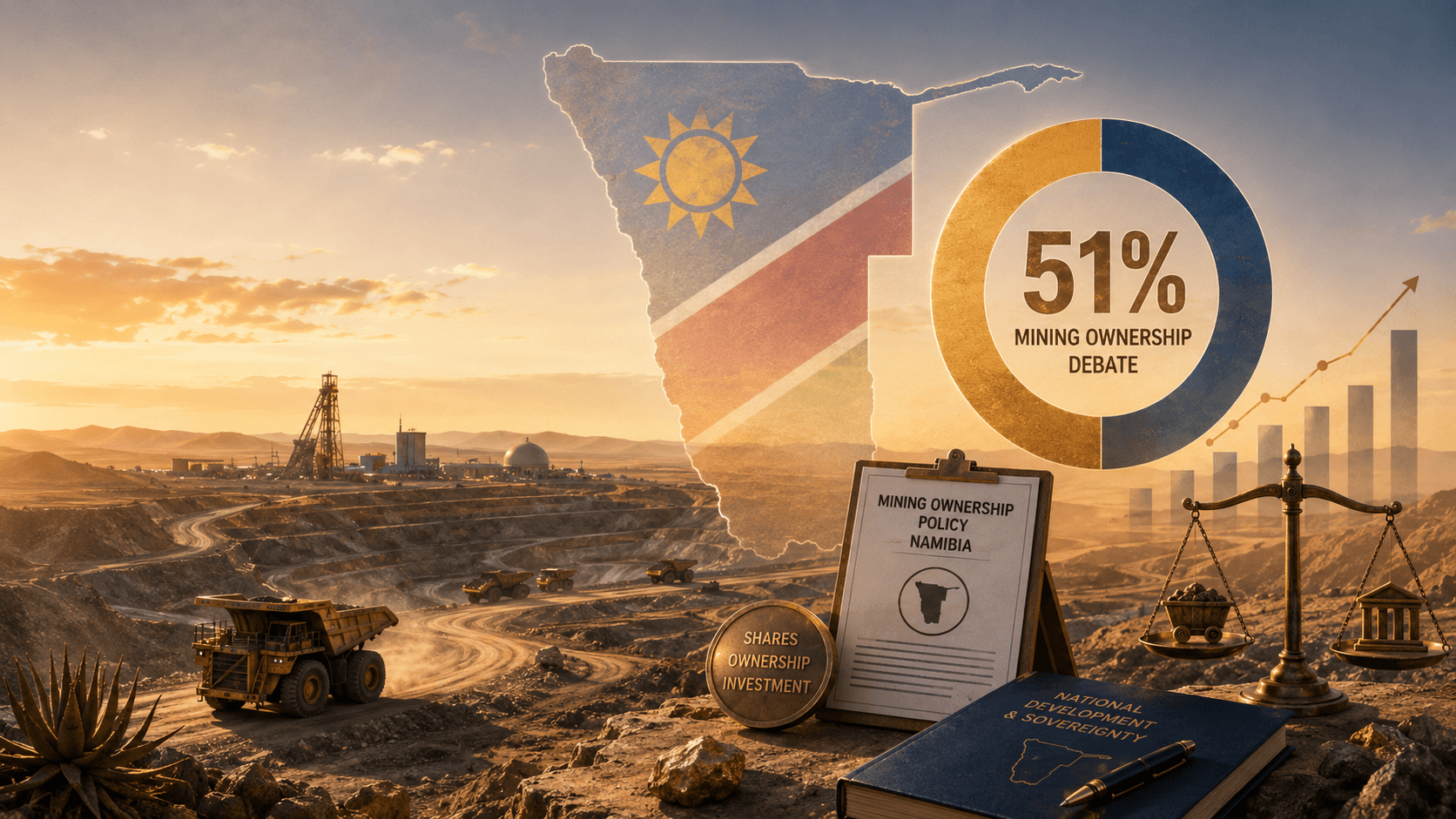
Namibia’s 51% Mining Ownership Debate Explained
Does the Namibian government really want to take control of 51% of every mine? Is the country moving towards nationalisation? Or is the proposal really about ensuring that Namibians receive a greater share of the wealth beneath their soil?
Over the past year, few economic policy discussions in Namibia have generated as much debate as the proposal that Namibians should own at least 51% of new mining ventures.
The idea has attracted support from those who believe Namibia receives too little from its enormous mineral wealth. It has also alarmed mining companies and investors, who argue that a mandatory majority-ownership requirement could make Namibia significantly less attractive as a place to invest.
The issue became even more confusing because different statements referred at various times to government ownership, Namibian ownership and local ownership — concepts that are not necessarily the same thing.
So, what was actually proposed? Is 51% local ownership now government policy? And what could such a system mean for Namibia?
Where did the 51% proposal come from?
The controversy came to a head at the Namibia Mining Expo and Conference in Windhoek in August 2025.
Then deputy prime minister and minister of industries, mines and energy Natangwe Ithete said government was consulting the mining industry on mechanisms that would increase Namibian participation in new mining ventures.
The figure that attracted the most attention was 51%.
Initial reporting described government as seeking 51% ownership in new mining ventures, while subsequent statements increasingly referred to a minimum of 51% Namibian or local ownership.
Ithete argued that Namibia needed to receive a much greater share of the economic value generated from its natural resources.
The proposal immediately became one of the most controversial economic policy discussions in the country.
The debate did not disappear after Ithete left Cabinet. In December 2025, he again publicly called for Namibians to demand a minimum of 51% ownership of mines, while also calling for greater beneficiation, industrialisation and processing of Namibia's raw materials inside the country.
Why 51%?
The significance of 51% is straightforward.
A shareholder with more than half of a company's voting rights can generally exercise majority control, although the actual powers of shareholders depend on the company's structure and shareholder agreements.
The difference between owning 49% and 51% is therefore much bigger than two percentage points might suggest.
A policy requiring Namibians to collectively own at least 51% of a mining venture would mean that foreign investors could no longer automatically own the majority of a new mine.
That would represent a major change from Namibia's present investment framework.
The Chamber of Mines currently describes Namibia's mining tax and investment regime as permitting 100% foreign ownership, with no compulsory government shareholding across the mining sector.
There are, however, already important exceptions and partnerships.
Perhaps the best-known is Namdeb, which is owned equally by the Government of Namibia and De Beers.
The question is whether arrangements involving greater Namibian ownership should become the norm rather than the exception.
Does 51% local ownership mean 51% government ownership?
Not necessarily. This distinction is essential to understanding the controversy.
There are at least three different ideas that are often mixed together in this debate:
- Government ownership means the Namibian state owns shares in a mining company, either directly or through a state-owned entity.
- Local ownership could include government, but it could also include Namibian private companies, pension funds, institutional investors, employees, communities or individual Namibian shareholders.
- Nationalisation generally refers to the state taking ownership or control of privately owned assets or industries.
Those are not the same thing.
A mine that is 51% owned by Namibian pension funds, businesses and private citizens would satisfy a broad definition of majority local ownership without being a state-owned mine.
The problem during the initial debate was that exactly who would be expected to own the 51% — and how that ownership would be financed — was not always clear.
That uncertainty contributed substantially to the reaction from investors.
So, is Namibia nationalising its mines?
No.
As of August 2026, Namibia has not adopted a policy nationalising its mining industry, nor is there a blanket law requiring the government to own 51% of mining companies.
In fact, the government subsequently moved to clarify that there is no fixed 51% local-ownership threshold currently in force.
Following discussions between the Chamber of Mines and President Netumbo Nandi-Ndaitwah, the National Planning Commission stated that government had not established a fixed local-ownership percentage.
The NPC indicated that government remained open to consultation aimed at achieving greater local empowerment while preserving profitability and investment returns.
According to the Chamber of Mines, President Nandi-Ndaitwah also told industry representatives that the proposed 51% threshold did not constitute formal government policy.
That clarification is important.
“Namibia is forcing investors to give government 51% of every mine” is not an accurate description of current policy.
But that does not mean the broader local-ownership debate has disappeared.
NDP6 made the situation more confusing
Namibia's Sixth National Development Plan, or NDP6, covers the period from 2025/26 to 2029/30 and places substantial emphasis on economic transformation, beneficiation, employment and greater Namibian participation in the economy.
The mining industry's concern was that NDP6 appeared to contain a 51% local-ownership baseline for mining licences, together with a higher target towards 2030.
According to the Chamber of Mines, these figures were not introduced during the initial consultations in the form in which they subsequently appeared.
The National Planning Commission later indicated that the figures required further interpretation and recalibration, while reiterating that government had not established a mandatory fixed ownership threshold.
That created an unusual situation in which a headline ownership target appeared in a national planning document while government simultaneously maintained that no fixed threshold had been formally adopted as policy.
For investors making decisions involving billions of dollars and projects that may operate for several decades, that distinction matters enormously.
Why does government want more Namibian ownership?
The argument in favour of greater local ownership begins with a simple question:
If the minerals belong to Namibia, how much of the economic value generated from them should remain in Namibia?
Namibia is exceptionally rich in minerals.
The country is a major uranium producer and has substantial deposits of diamonds, gold, copper, zinc, lithium and other minerals. Recent offshore petroleum discoveries have added another potentially enormous source of natural-resource wealth.
Yet Namibia continues to struggle with unemployment, poverty and high levels of inequality.
That creates an understandable political question.
If billions of dollars of uranium, diamonds, metals and potentially oil are extracted from Namibia, should Namibians merely collect taxes and wages from those industries?
Or should Namibians also own a substantial part of the companies producing that wealth?
Supporters of increased local ownership argue that equity participation could allow more profits and dividends to remain in Namibia.
It could also potentially help build Namibian-owned companies, increase local procurement, develop technical expertise and give communities a more direct economic interest in the country's natural resources.
For supporters, the debate is therefore not necessarily about hostility towards foreign investors.
It is about resource sovereignty.
Namibia already earns money from mining without owning the mines
It is important, however, to distinguish ownership from economic participation.
Government does not need to own 51% of a mine to receive income from it.
Mining companies already contribute through mechanisms including:
- corporate income tax;
- mineral royalties;
- export levies;
- employee taxes;
- licence fees;
- local procurement;
- salaries and employment; and
- dividends where government already holds equity.
Namibia also applies particularly high taxation to certain types of mining.
The Chamber of Mines lists a corporate income-tax rate of 55% for diamond mining and 37.5% for non-diamond mining, in addition to applicable royalties and other charges.
Critics of compulsory majority ownership therefore argue that the more important question is not simply:
“Who owns the mine?”
It is:
“How much total value does Namibia receive from the mine?”
A mine that is privately owned but employs thousands of Namibians, buys billions of dollars of goods locally and pays substantial taxes could conceivably generate more national benefit than a mine in which the state owns a large stake but which is unprofitable.
Why are mining companies worried?
Mining is different from many ordinary businesses because of the extraordinary amount of money required before a company knows whether it will make a profit.
An exploration company may spend years searching for a deposit.
It may drill hundreds of exploration holes, conduct geological studies, commission environmental assessments and spend millions — or even billions — developing infrastructure.
And after all that, the project may still fail.
That makes ownership requirements particularly sensitive.
Imagine an international investor provides most of the capital and assumes most of the exploration risk but is told that, if the project succeeds, it may only own 49%.
The obvious question becomes:
Who pays for the other 51%?
If Namibian shareholders purchase their stakes at market value, the issue is largely one of raising enough local capital.
But if foreign investors are required to surrender part of their equity without receiving equivalent value, the economics of investing in Namibia become very different.
This is why the precise design of any future local-ownership model is more important than the headline percentage itself.
The proposal affected investor confidence
The Chamber of Mines says the 2025 announcement caused significant concern internationally.
According to its 2025 annual review, some companies with Namibian mining interests listed on the Australian Securities Exchange temporarily suspended trading while they sought clarity about the implications of the proposed policy.
The Chamber subsequently warned that uncertainty around mining policy was affecting Namibia's attractiveness as an investment destination.
The concern is straightforward.
Mining companies compete globally for capital.
A company considering spending hundreds of millions of dollars on a uranium project in Namibia may also have potential projects in Canada, Australia, Botswana, Zambia or elsewhere.
If investors believe Namibia's rules could change after they have committed capital, the perceived risk increases.
And the higher the perceived risk, the higher the return investors generally expect before putting money into a project.
But Namibia also has considerable bargaining power
The other side of the argument is that minerals cannot simply relocate to another country.
An investor looking for uranium cannot take a Namibian uranium deposit and move it to Australia.
Namibia possesses resources the world increasingly wants.
Uranium is attracting renewed global interest as countries reconsider nuclear power. The energy transition has increased demand for critical minerals. And Namibia's offshore oil discoveries have placed the country on the radar of some of the world's largest energy companies.
Government therefore has legitimate bargaining power.
The challenge is deciding how aggressively to use it.
If conditions are too generous, Namibia risks watching much of the value generated by its natural resources leave the country.
If conditions are too demanding, resources could remain underground because investors decide that developing them is not commercially worthwhile.
The optimal point lies somewhere between those extremes.
Government's position appears to have become more pragmatic
More recent comments from the current minister of industries, mines and energy, Modestus Amutse, suggest government is taking a more nuanced approach.
In July 2026, Amutse said Namibia would ideally like substantial participation in mining and petroleum projects, potentially around a 50-50 arrangement, but acknowledged that government must take the enormous financial risks faced by exploration investors into account.
He also warned that unrealistic ownership demands could cause investors to take their money elsewhere.
That is notably different from presenting 51% as a rigid requirement.
The emerging position appears to be that Namibia wants greater economic participation in its natural resources, but that the mechanism and percentage must be commercially workable.
Exactly what that model will eventually look like remains unresolved.
What options does Namibia have?
The debate does not necessarily have to result in a choice between 0% and 51%.
There are many possible models.
Government equity
The state could acquire shares in strategically important mining projects, either directly or through a state-owned mining company.
Free-carried interest
Government could receive a smaller percentage of a mining project without paying all of the exploration and development costs normally associated with that stake.
A government free-carried interest of around 10% had previously been discussed before the 51% controversy emerged.
Pension-fund investment
Namibian pension and institutional capital could be encouraged to invest more directly in profitable resource projects.
That would increase Namibian ownership without necessarily increasing government ownership.
Employee or community ownership
A percentage of mining projects could potentially be reserved for employees or communities affected by mining operations.
Local stock-market listings
Large mining companies operating in Namibia could potentially be encouraged or required to list part of their equity locally, giving Namibian investors an opportunity to participate.
Stronger local procurement
Instead of focusing exclusively on who owns the mine, government could require mining companies to purchase more products and services from Namibian businesses.
Beneficiation
Namibia could focus more aggressively on processing its resources domestically rather than exporting raw materials.
For example, the economic benefit of a mineral may be considerably greater if more refining, manufacturing or value addition happens inside Namibia.
These approaches are not mutually exclusive.
The real debate is bigger than 51%
Ultimately, the controversy is not really about a single percentage.
It is about a much larger question:
How should Namibia turn its natural-resource wealth into long-term prosperity for Namibians?
Foreign investment has played an enormous role in developing Namibia's mining industry.
Without outside capital, technology, expertise and access to international markets, many of the country's mines would never have been built.
At the same time, Namibia has every reason to ask whether enough of the wealth generated by those resources remains inside the country.
Those two ideas do not have to be contradictory.
The challenge for government is to build a system in which investors can earn an adequate return for taking considerable financial risks while Namibia receives an appropriate share of the resulting economic value.
That requires predictable rules.
It also requires clarity about what terms such as “local ownership” actually mean.
So what is the situation today?
As of August 2026, the simplest summary is this:
Namibia does not currently have a blanket policy requiring government to own 51% of every mine.
A proposal for 51% local ownership of new mining ventures was publicly advanced in 2025 and generated considerable controversy.
President Netumbo Nandi-Ndaitwah and the National Planning Commission subsequently clarified that no fixed 51% local-ownership threshold had been formally adopted as government policy.
Government has nevertheless made it clear that it wants Namibians to receive a greater share of the economic value generated by mining and other natural resources.
More recent comments from mines minister Modestus Amutse indicate that greater state or local participation remains an objective — but one that government says must be balanced against investment risk and commercial reality.
That means the 51% debate is not over.
It has simply evolved.
The question facing Namibia is no longer merely whether the country should demand 51%.
It is whether Namibia can design a model that allows its people to own and benefit from more of their natural-resource wealth without discouraging the investment needed to turn those resources into productive mines in the first place.
That may prove to be one of the most consequential economic policy debates Namibia faces over the next decade.
This article reflects publicly available information as of August 2026. Mining ownership policy remains under discussion, and future legislation or government policy may change the position described above.
Sources
- The Namibian — Local ownership push: Govt eyes 51% stake in new mining ventures
- The Namibian — Ithete pushes for 51% local ownership in mines
- Chamber of Mines of Namibia — Mining Tax Regime
- Chamber of Mines of Namibia — 2025 Annual Review
- National Planning Commission — Sixth National Development Plan
- Namibian Sun — 51% mines ownership proposal not government policy
- Namibian Sun — Namibia won't scare off investors with unrealistic equity demands
POPULAR ARTICLES
View all