
Why N$1 Is Always Worth R1
If you have ever wondered why N$100 and R100 are worth exactly the same amount, the answer lies in one of the most important — but often overlooked — features of Namibia's economy.
The Namibia Dollar is pegged to the South African Rand at a fixed exchange rate of one to one. In other words:
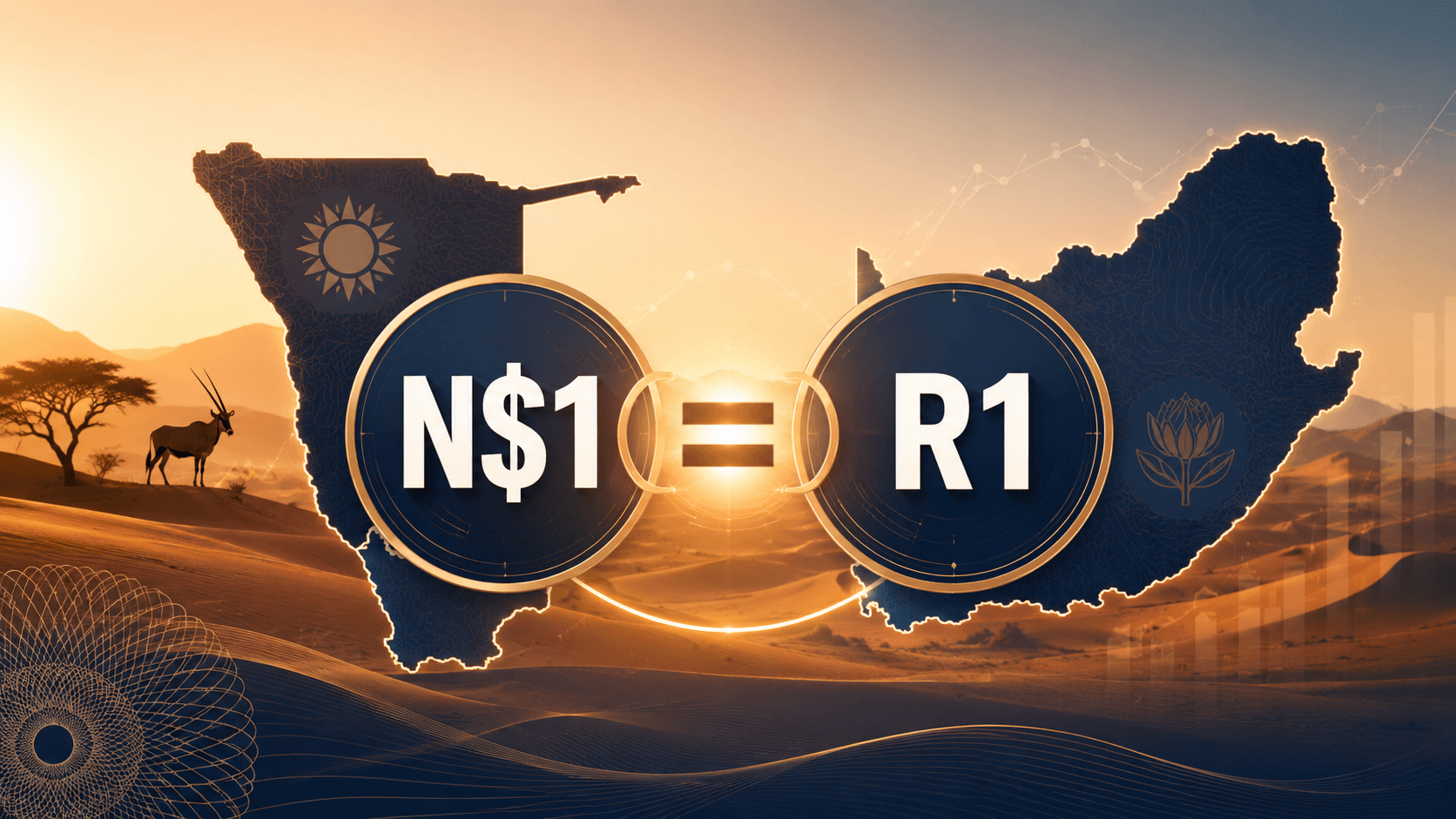
N$1 = R1
This is not simply because the two currencies happen to trade at similar values. It is a deliberate monetary arrangement maintained by the Bank of Namibia and supported by Namibia's membership of the Common Monetary Area.
So why did Namibia choose this system, how does it work, and what does it mean for ordinary Namibians?
First, what does "pegged to the rand" actually mean?
Most currencies move in value against one another every day. The value of the US Dollar against the Euro, for example, is determined largely by international currency markets.
The Namibia Dollar works differently when compared with the South African Rand. Namibia maintains a fixed exchange rate between the two currencies. The official value of one Namibia Dollar is always one South African Rand.
This means that if the rand strengthens against the US Dollar, the Namibia Dollar strengthens with it. If the rand weakens, the Namibia Dollar weakens by the same amount.
For example, if the exchange rate is:
- R18.50 = US$1
then the corresponding Namibia Dollar exchange rate will also effectively be:
- N$18.50 = US$1
The Namibia Dollar therefore does not have an independent exchange rate against the rand.
It starts with the Common Monetary Area
Namibia belongs to the Common Monetary Area (CMA), a monetary arrangement consisting of:
- Namibia
- South Africa
- Lesotho
- Eswatini
Within this arrangement, the currencies of Namibia, Lesotho and Eswatini are pegged to the South African Rand on a one-to-one basis.
Capital can also move relatively freely between the CMA countries, while the member states maintain broadly compatible exchange-control arrangements with the rest of the world.
The rand effectively acts as the anchor currency for the monetary area.
But why did Namibia keep its currency linked to South Africa?
The answer is largely economic history and practicality.
Before independence, the South African Rand was the currency used in what was then South West Africa. When Namibia became independent in 1990, the new country established the Bank of Namibia and began creating its own national currency.
The Namibia Dollar was introduced in September 1993.
Introducing a national currency was important for Namibia's identity and monetary sovereignty, but completely separating the new currency from the rand would also have introduced exchange-rate risk into an economy that was already closely linked to South Africa.
The solution was effectively to have both:
- a distinctly Namibian national currency; and
- a stable one-to-one relationship with the South African Rand.
That arrangement continues today.
Why can you spend South African Rand in Namibia?
One of the most visible consequences of the arrangement is that South African Rand notes and coins are legal tender in Namibia.
This is why a shop in Windhoek, Swakopmund or Oshakati can accept an R100 note exactly as it would accept an N$100 note.
Because the exchange rate is fixed at one to one, there is no currency conversion calculation required at the till.
There is, however, an important difference in the other direction: the Namibia Dollar is not generally legal tender in South Africa.
A Namibian travelling to South Africa should therefore not assume that a South African business will accept Namibia Dollar cash, even though the currencies have the same official value.
How does Namibia keep N$1 equal to R1?
A fixed exchange rate requires more than simply declaring that two currencies have the same value.
The Bank of Namibia has to conduct monetary policy in a way that protects the one-to-one parity.
An important part of that system is Namibia's stock of international reserves. Under the Common Monetary Area arrangement, Namibia is required to maintain sufficient reserves to support the Namibia Dollars in circulation.
The Bank of Namibia therefore pays close attention to the country's foreign reserves, capital flows and monetary conditions when making policy decisions.
What does this have to do with interest rates?
Quite a lot.
Because money can move between Namibia and South Africa relatively freely, Namibia cannot set interest rates without considering what is happening in South Africa.
Imagine, for example, that interest rates in South Africa rose dramatically while rates in Namibia remained much lower. Investors could have an incentive to move money from Namibia into South Africa in search of better returns.
Large capital movements of this kind could put pressure on Namibia's foreign reserves and ultimately on the currency peg.
This is one reason the Bank of Namibia's monetary policy often moves broadly in line with monetary conditions in South Africa.
It does not mean every economic decision in Namibia is made in Pretoria. It does mean that maintaining the currency peg places real limits on how far Namibian monetary policy can diverge from South Africa's.
What are the advantages for Namibia?
The arrangement has several practical benefits.
1. Exchange-rate stability
Namibian businesses trading with South Africa do not have to worry about the Namibia Dollar suddenly gaining or losing 10% against the rand.
N$1 today is worth R1 tomorrow as long as the peg remains in place.
2. Easier cross-border trade
Namibia and South Africa have deeply interconnected economies. A common monetary framework makes payments, pricing and financial relationships between the two countries considerably simpler.
3. Less currency uncertainty
A small, independently floating currency can sometimes experience large swings in value. Pegging the Namibia Dollar to a much larger regional currency provides a degree of exchange-rate stability.
4. Familiarity for consumers and businesses
Namibians can receive South African Rand, use it locally and understand its value immediately. There is no need to constantly calculate a NAD/ZAR exchange rate.
What are the disadvantages?
The biggest trade-off is monetary independence.
Namibia has its own central bank, its own currency and its own monetary policy decisions, but those decisions have to take the currency peg into account.
Namibia cannot simply allow its interest rates, money supply and financial conditions to diverge indefinitely from South Africa without potentially putting pressure on the one-to-one exchange rate.
Namibia also effectively inherits movements in the value of the rand against international currencies.
If the rand loses value against the US Dollar, the Namibia Dollar loses value against the US Dollar too.
That can affect the cost of imported products priced in foreign currencies, including machinery, electronics, vehicles and some fuel-related costs.
So is N$1 really always worth R1?
At the official exchange rate, yes — while the current peg remains in place.
N$500 and R500 represent the same monetary value under the Common Monetary Area arrangement.
That does not necessarily mean every transaction is completely cost-free. Banks and financial service providers can still charge transaction, transfer or other service fees. Similarly, the fact that two currencies have equal value does not mean that Namibia Dollar cash must be accepted by businesses outside Namibia.
Those are payment and legal-tender issues rather than changes to the official exchange rate.
Could Namibia ever stop pegging the Dollar to the Rand?
In principle, Namibia could adopt a different monetary or exchange-rate system in the future.
But abandoning the peg would be a major economic policy decision. Namibia would need to determine how the Namibia Dollar should be valued, how its exchange rate should be managed and how the country would handle the resulting changes to trade, investment, interest rates and capital flows.
For now, maintaining the one-to-one exchange rate remains a central part of the Bank of Namibia's monetary policy framework.
The simple answer
So, why is N$1 worth exactly R1?
Because Namibia has deliberately chosen to peg its currency to the South African Rand as part of the Common Monetary Area.
The arrangement gives Namibia its own national currency while maintaining a stable exchange rate with South Africa. In return, Namibia accepts some limits on how independently it can conduct monetary policy.
That little N$ symbol on your money therefore tells a much bigger story: one about Namibia's independence, its economic relationship with its neighbours, and the monetary system that has underpinned the Namibia Dollar since its introduction in 1993.
Sources: Bank of Namibia — Monetary Policy Framework, Common Monetary Area information and History of Namibian Currency. This article is intended as a general explanation and does not constitute financial advice.
POPULAR ARTICLES
View all