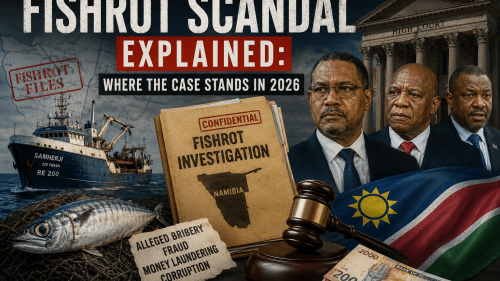

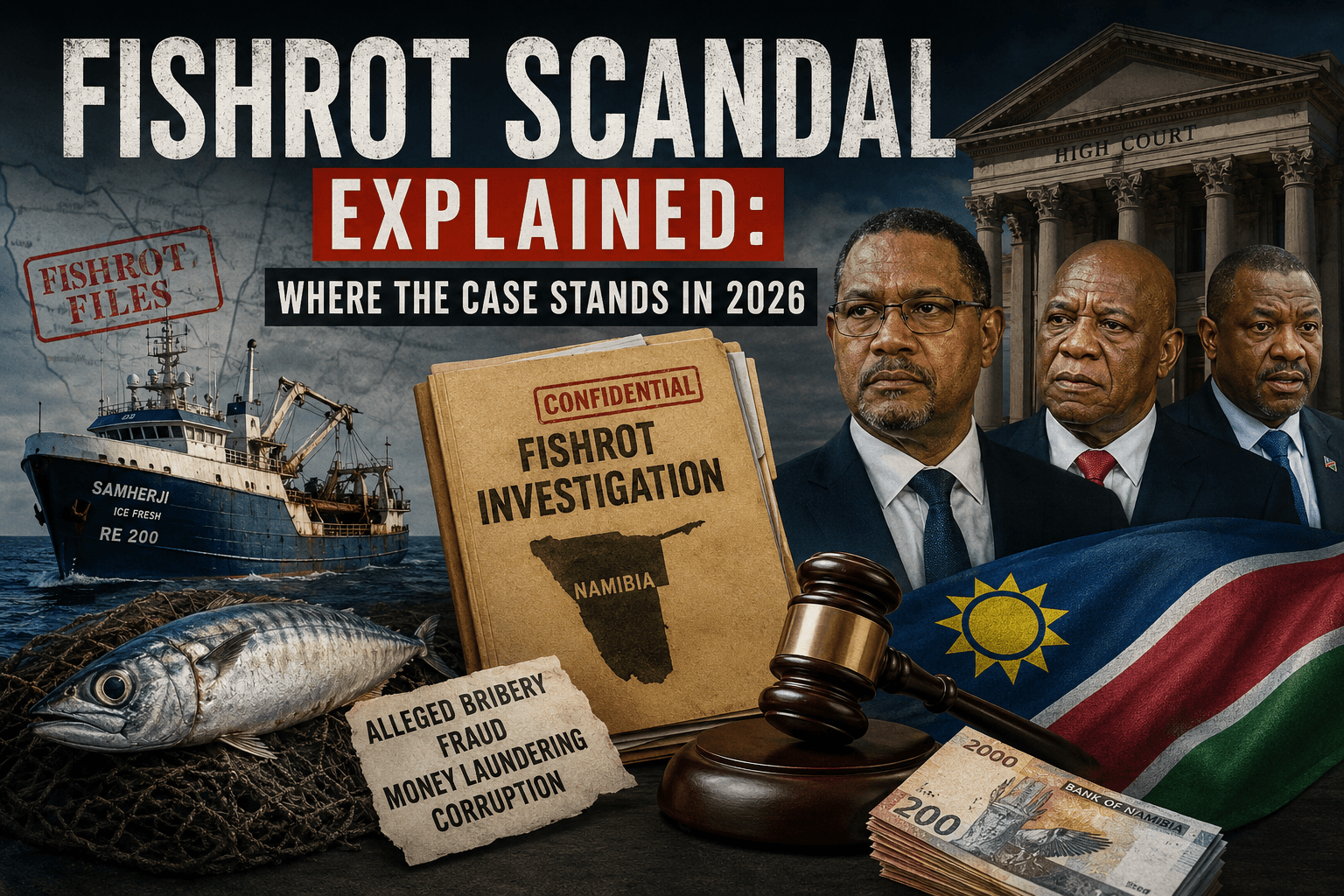
Fishrot Scandal Explained: Where the Case Stands in 2026
It has been nearly seven years since the Fishrot scandal exploded into public view and became one of the biggest corruption cases in Namibia's history.
Two former Cabinet ministers resigned. Senior business figures were arrested. An Icelandic fishing giant was accused of paying millions in bribes for access to Namibia's valuable fishing quotas. Tens of thousands of leaked documents exposed an international network of companies, payments and political connections.
Yet in 2026, one of the biggest questions surrounding Fishrot remains surprisingly simple:
When will the main trial actually get underway?
The ten individual accused have already had not-guilty pleas recorded on 42 charges, including corruption, fraud, racketeering and money laundering. But a series of applications, appeals, recusal attempts and other procedural disputes have repeatedly interrupted progress.
As of August 2026, the criminal case has again been postponed — this time until 19 October 2026.
This is where the Fishrot scandal came from, what prosecutors allege happened, who is accused, and why the case remains unresolved so many years later.
What Is the Fishrot Scandal?
At its core, Fishrot is about Namibia's fishing quotas and allegations that politically connected individuals used their positions and connections to turn those quotas into private financial benefits.
Namibia has one of the world's most productive marine ecosystems. Fishing rights and quotas are therefore enormously valuable economic assets.
The State alleges that between 2011 and 2019, a group of Namibian officials, businessmen and associated companies participated in arrangements that allowed the Icelandic fishing group Samherji to gain access to valuable Namibian fishing quotas.
Prosecutors allege that quotas intended to serve governmental or public objectives were instead channelled through structures that ultimately benefited private interests.
The allegations include claims of bribery, corruption, fraud, money laundering and racketeering.
Samherji has denied criminal wrongdoing in connection with the scandal.
How Was Fishrot Exposed?
The scandal became public in November 2019 following the release of what became known as the Fishrot Files.
A former Samherji executive in Namibia, Jóhannes Stefánsson, became a whistleblower and provided more than 30,000 documents, including emails, invoices, internal correspondence and other records.
The material was published through WikiLeaks and investigated by journalists in Namibia, Iceland and internationally.
The documents appeared to provide an extraordinary inside view of how fishing deals were negotiated, how companies were structured and how money allegedly flowed between entities connected to the fishing arrangements.
A detailed background on the whistleblower disclosures is available from the Platform to Protect Whistleblowers in Africa .
The original leaked documents can also be found in the WikiLeaks Fishrot Files archive .
The Alleged Fishing-Quota Scheme
The Fishrot case is complicated because it does not involve a single alleged bribe or one suspicious transaction.
Instead, the State alleges that there was a broader scheme involving fishing quotas, government decisions, private companies and the movement of money through multiple entities.
One important part of the allegations concerns fishing quotas allocated under arrangements involving Namibia and Angola.
Prosecutors allege that companies connected to the arrangement obtained access to quotas supposedly intended to advance governmental objectives, while Samherji ultimately gained access to the fish.
The State alleges that payments associated with those fishing arrangements were then distributed among individuals and entities involved in the scheme.
One of the fraud charges concerns fishing quotas valued at approximately N$150 million, although allegations surrounding the wider Fishrot operation involve substantially larger flows of money.
The criminal trial will ultimately have to determine which of these allegations the prosecution can actually prove.
Who Is Accused in the Namibian Fishrot Case?
The main criminal prosecution currently involves ten individual accused:
- Ricardo Gustavo
- Bernhard Esau, former minister of fisheries and marine resources
- Sacky Shanghala, former attorney general and minister of justice
- James Hatuikulipi, former managing director of Investec Asset Management Namibia
- Tamson Hatuikulipi, businessman and Esau's son-in-law
- Pius Mwatelulo
- Mike Nghipunya, former chief executive of the National Fishing Corporation of Namibia (Fishcor)
- Nigel van Wyk
- Otneel Shuudifonya
- Phillipus Mwapopi
A number of companies, close corporations and trusts are also included in the prosecution.
The phrase "Fishrot Six" became widely used during the early stages of the scandal, but the eventual criminal prosecution grew beyond those six original high-profile suspects.
What Are They Charged With?
The accused face a total of 42 charges.
The indictment includes allegations involving:
- racketeering;
- corruption;
- fraud;
- money laundering;
- conspiracy;
- theft;
- corruptly using a public office or position to obtain gratification;
- contraventions of the Prevention of Organised Crime Act;
- contraventions of anti-corruption legislation; and
- defeating or obstructing the course of justice.
All of the accused have had pleas of not guilty recorded on the charges against them.
That point is important. The existence of leaked documents, arrests, criminal charges and asset-restraint proceedings does not amount to a criminal conviction.
The State still has to prove its allegations in court.
Why Did Two Cabinet Ministers Resign?
The political consequences were almost immediate when the scandal broke in November 2019.
Then-fisheries minister Bernhard Esau and then-justice minister Sacky Shanghala resigned from their Cabinet positions after the allegations became public.
Both were subsequently arrested and became central accused in the criminal case.
The scandal was particularly damaging politically because the allegations involved people who had occupied some of the most powerful positions in Namibia's government.
It was therefore never simply a story about fishing.
Fishrot became a test of Namibia's institutions, its anti-corruption mechanisms and its ability to prosecute politically connected individuals.
So Why Has the Trial Taken So Long?
This has become one of the defining questions of the Fishrot case.
The first arrests took place in late 2019. Yet years later, the court has still spent much of its time dealing with preliminary and procedural disputes rather than hearing the State's substantive evidence against the accused.
The case has encountered disputes involving:
- legal representation;
- bail applications;
- applications for postponements;
- attempts to have judges recuse themselves;
- challenges to the appointment of judges;
- requests for separate trials;
- appeal applications;
- challenges to Anti-Corruption Commission investigations; and
- constitutional and procedural questions surrounding the prosecution.
The complexity of the case is real. The prosecution involves numerous accused, corporate entities, large amounts of documentation and transactions involving several jurisdictions.
At the same time, judges involved in the case have repeatedly expressed concern about how long the matter has taken to reach a substantive trial.
The Pleas Were Finally Completed
Plea proceedings themselves became a lengthy process.
They initially started in December 2023 but were interrupted by an application asking then-presiding acting judge Moses Chinhengo to recuse himself.
The pleas eventually resumed, and by December 2024, not-guilty pleas had been recorded for all of the accused on all 42 charges.
That should normally have cleared the way for the prosecution to begin presenting evidence.
Instead, further procedural battles followed.
A New Judge and Another Attempt to Start the Trial
Acting judge Marilize du Plessis later took over the case.
In January 2026, she rejected applications seeking a lengthy postponement and scheduled the trial to proceed from 9 to 20 March 2026.
Some of the accused were asking for the criminal proceedings to be delayed while they pursued a separate civil challenge concerning the legality of aspects of the Anti-Corruption Commission's investigation and the prosecution.
Du Plessis rejected the attempt to delay the criminal trial for that reason.
But that did not end the litigation.
Then Came Another Recusal Battle
Former justice minister Sacky Shanghala subsequently asked Du Plessis to recuse herself from the Fishrot case.
Among other arguments, he contended that comments made by the judge about the history of delays created a reasonable apprehension of bias.
Du Plessis rejected the application in March 2026.
She said her observation that the case had experienced significant delays was based on the factual procedural history of the matter and did not demonstrate bias against the accused.
Shanghala then sought to appeal that decision.
This created yet another dispute over whether the criminal trial could continue while appeal efforts were underway.
Where Does the Fishrot Trial Stand in August 2026?
This brings us to the current position.
On 16 July 2026, the High Court again postponed the Fishrot criminal case.
The next scheduled date is:
19 October 2026.
At the July court appearance, Shanghala informed the court that the Supreme Court had not yet decided a petition in which he is seeking permission to appeal against Du Plessis's refusal to recuse herself.
There is also another important case moving through the High Court.
Shanghala, James Hatuikulipi, Pius Mwatelulo and Otneel Shuudifonya are seeking orders that would halt their prosecution while the court deals with a wider challenge concerning aspects of the investigation and prosecution.
The hearing of that application was scheduled for 15 September 2026.
That means there are two important dates to watch:
- 15 September 2026: scheduled hearing of the separate High Court application seeking to stop aspects of the prosecution.
- 19 October 2026: the main Fishrot criminal case is scheduled to return to court.
The latest court update can be read at The Namibian .
What Has Happened in Iceland?
Fishrot has never been a purely Namibian affair.
Because Samherji is an Icelandic company and much of the documentary evidence originated from its operations, Icelandic authorities have also investigated the matter.
In July 2025, Iceland's District Prosecutor concluded a roughly five-year investigation into Samherji's activities in Namibia.
At the time the investigation was completed, prosecutors had not yet announced whether criminal charges would be brought. Nine current or former Samherji employees reportedly had formal status as defendants during the investigation.
As of 2026, the question of accountability in Iceland therefore remains an important part of the international Fishrot story.
Background on the Icelandic investigation is available from Icelandic public broadcaster RÚV .
More Than 1,000 Namibian Workers Are Now Seeking Recognition as Victims
One of the most significant developments in 2026 has come from former Namibian fisheries workers.
In July, more than 1,000 Namibian workers, supported by Transparency International, submitted claims to Icelandic prosecutors asking to be formally recognised as victims in possible criminal proceedings connected to Fishrot.
The workers argue that the alleged corruption caused direct harm to their livelihoods.
They say the consequences included job losses, food insecurity, difficulty paying for housing and education, debt and psychological distress.
The effort could become legally significant beyond Namibia because it raises a wider question: Can workers who lose their livelihoods as a result of foreign bribery be formally recognised as victims of the corruption itself?
More information is available from Transparency International .
There Is Now a Major Civil Claim Against Samherji Too
The criminal proceedings are not the only legal battle resulting from Fishrot.
In 2026, a major civil claim connected to Namibia's state-owned fishing company Fishcor was brought against Samherji and associated interests.
Fishcor assigned its claim to Restitution Litigation Limited, which is pursuing litigation seeking the return of money it alleges was extracted from Namibia through corrupt fishing-quota arrangements.
Reports from Iceland have placed the claim at as much as approximately US$1 billion.
Samherji has rejected the claim and denied wrongdoing.
The civil litigation is legally separate from the Namibian criminal trial, and the allegations in that case will likewise have to be established in court.
Icelandic public broadcaster RÚV has more on the civil proceedings: Lawsuit Against Samherji About Returning Funds to Namibian People .
What Happened to Fishcor?
Fishcor — the National Fishing Corporation of Namibia — became one of the central institutions associated with Fishrot.
Former Fishcor chief executive Mike Nghipunya is among the accused in the criminal case.
The prosecution alleges that Fishcor and related structures were used as part of arrangements through which fishing quotas and money moved.
The state-owned company has subsequently tried to distance itself from that period and is now itself involved in efforts to recover money allegedly lost through the scandal.
Why Fishrot Matters Beyond the Courtroom
It would be easy to treat Fishrot simply as a complicated corruption trial involving former politicians.
Its significance is much larger.
Fishing quotas are not merely pieces of paper issued by government.
They represent access to a national natural resource capable of generating jobs, taxes, foreign currency, food and economic activity.
If those rights are allocated corruptly, the cost is not limited to the amount of a bribe.
The opportunity cost can include businesses that never receive quotas, workers who lose employment, communities that lose economic activity and public revenue that never reaches the state.
That is one reason Fishrot has remained such an important national issue.
The Scandal Also Changed Namibian Politics
Fishrot erupted shortly before Namibia's 2019 general election.
The spectacle of two Cabinet ministers resigning amid allegations involving public resources damaged public trust and placed corruption at the centre of national political debate.
Since then, Fishrot has become shorthand in Namibia for something broader than the specific criminal case.
It is regularly invoked in discussions about political accountability, public procurement, natural-resource governance, the independence of institutions and the relationship between business and political power.
Why the Delays Matter
The repeated delays create a difficult tension.
Every accused person has constitutional rights, including the right to legal representation, the right to challenge allegedly unlawful state action and the right to receive a fair trial.
Those protections remain important even in a case attracting enormous public anger.
But accused persons also have a right to be tried within a reasonable period, particularly where they have spent long periods in detention.
The public has an interest in seeing serious corruption allegations adjudicated rather than remaining unresolved indefinitely.
Witnesses, workers and institutions affected by the scandal also have an interest in finality.
Nearly seven years after the first arrests, that finality has still not arrived.
Has Anyone Been Found Guilty of Fishrot Yet?
Not in Namibia's main Fishrot criminal trial.
This is perhaps the most important point when discussing the case.
The ten accused have been charged and have had not-guilty pleas recorded.
The prosecution has made serious allegations.
There are leaked documents, financial records, whistleblower testimony and years of investigation surrounding the case.
But the purpose of the trial is to determine whether the State can prove the individual criminal charges beyond reasonable doubt.
Until that happens, the accused are entitled to the presumption of innocence.
What Happens Next?
The immediate focus is on the outstanding litigation.
The High Court is scheduled to hear an application on 15 September 2026 in which several accused are seeking to stop their prosecution while their broader legal challenge is determined.
Then, unless another court order or procedural development intervenes, the main criminal matter is scheduled to return on 19 October 2026.
The central question is whether the court will finally move beyond pre-trial disputes and begin hearing the evidence underlying the 42 charges.
That evidence is what will ultimately determine whether one of Namibia's largest corruption scandals also becomes one of its most consequential corruption convictions — or whether the State fails to prove some or all of its case.
Seven Years Later, Namibia Is Still Waiting
The Fishrot Files changed Namibia almost overnight in 2019.
They exposed allegations about how political power, private business and one of the country's most valuable natural resources became intertwined.
The scandal led to resignations, arrests, frozen assets, international investigations and criminal charges against some of Namibia's most prominent former officials and business figures.
But exposure is not the same as accountability.
That requires a functioning legal process capable of examining the evidence, protecting the rights of the accused and ultimately reaching a verdict.
As Namibia enters the second half of 2026, Fishrot therefore remains unfinished business.
The scandal has been exposed. The accused have been charged. The pleas have been entered. But the central evidence has still not been tested through a completed criminal trial.
For Namibia, the real legacy of Fishrot may ultimately depend on what happens next.
This article was updated using information available as of August 2026. The individuals charged in the Namibian Fishrot case have pleaded not guilty, and allegations against them should not be treated as proven unless established by a court.
Sources and Further Reading
- The Namibian – Fishrot Trial Postponed to October
- New Era – Fishrot Trial and the 42 Charges
- The Namibian – Judge Dismisses Fishrot Recusal Application
- PPLAAF – The Fishrot Scandal
- WikiLeaks – Fishrot Files
- Transparency International – More Than 1,000 Namibian Workers Seek Victim Status
- RÚV – Icelandic Investigation Into Samherji's Namibia Activities
- RÚV – Civil Claim Seeking Return of Funds to Namibia
POPULAR ARTICLES
View all