
Is Namibia About to Become an Oil-Producing Nation?
For decades, Namibia imported the petroleum products that keep its cars, trucks, mines and industries moving. Now, after a series of major offshore discoveries, the country is preparing for something entirely new: producing oil of its own.
The short answer is yes — Namibia is increasingly likely to become an oil-producing nation.
But not tomorrow.
As of August 2026, Namibia is still not producing crude oil commercially. Exploration, appraisal, engineering and negotiations are continuing, and the country's most advanced project is targeting first oil around 2030.
What has changed is the level of confidence.
Namibia has moved from being considered a highly speculative frontier exploration market to one of the world's most closely watched new offshore petroleum regions.
Companies including TotalEnergies, Shell, Galp, QatarEnergy, BP, Petrobras, Chevron and Azule Energy have all established or pursued interests in Namibian offshore acreage.
The question is therefore becoming less:
“Does Namibia have oil?”
and increasingly:
“When will Namibia actually start producing it?”
Namibia does not produce crude oil yet
This distinction is important.
Discovering oil is not the same as producing oil.
An exploration company can drill a well and find significant quantities of petroleum, but years of additional work may be required before that discovery becomes a commercial oil field.
Engineers need to determine how much oil can actually be recovered. More wells may need to be drilled. The project must be designed, environmental approvals obtained, agreements negotiated, contractors appointed and billions of dollars of investment committed.
Only after all of that can production begin.
Namibia is currently somewhere between the discovery and development stages.
The discovery that changed everything
Namibia had been searching for commercially viable offshore oil for decades.
Then, in 2022, the picture changed dramatically.
Major discoveries by Shell and TotalEnergies in the offshore Orange Basin demonstrated that Namibia's deep Atlantic waters contained a functioning petroleum system capable of holding very large quantities of hydrocarbons.
TotalEnergies' Venus discovery became particularly important.
Venus was not simply another exploration well. It was large enough to trigger years of appraisal drilling and engineering work aimed at turning the discovery into Namibia's first major offshore oil development.
Since then, additional discoveries — particularly the Mopane discovery originally led by Portuguese energy company Galp — have strengthened expectations that Namibia could eventually support several large offshore developments rather than a single oil field.
Venus is currently the project to watch
The most advanced project is TotalEnergies' Venus development.
TotalEnergies said in February 2026 that Venus had been fully appraised and contained around 750 million barrels of oil equivalent in resources.
The company's proposed development is designed for plateau production of approximately 150,000 barrels of oil equivalent per day.
To put that into perspective, 150,000 barrels per day would amount to roughly 55 million barrels per year if that production rate were maintained continuously.
TotalEnergies has said it is targeting first oil in 2030.
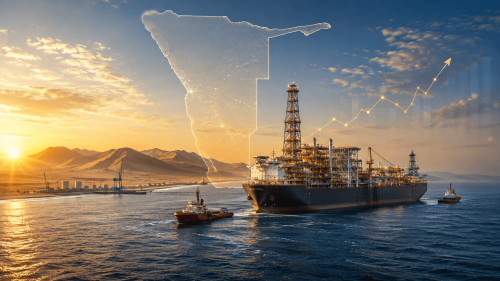
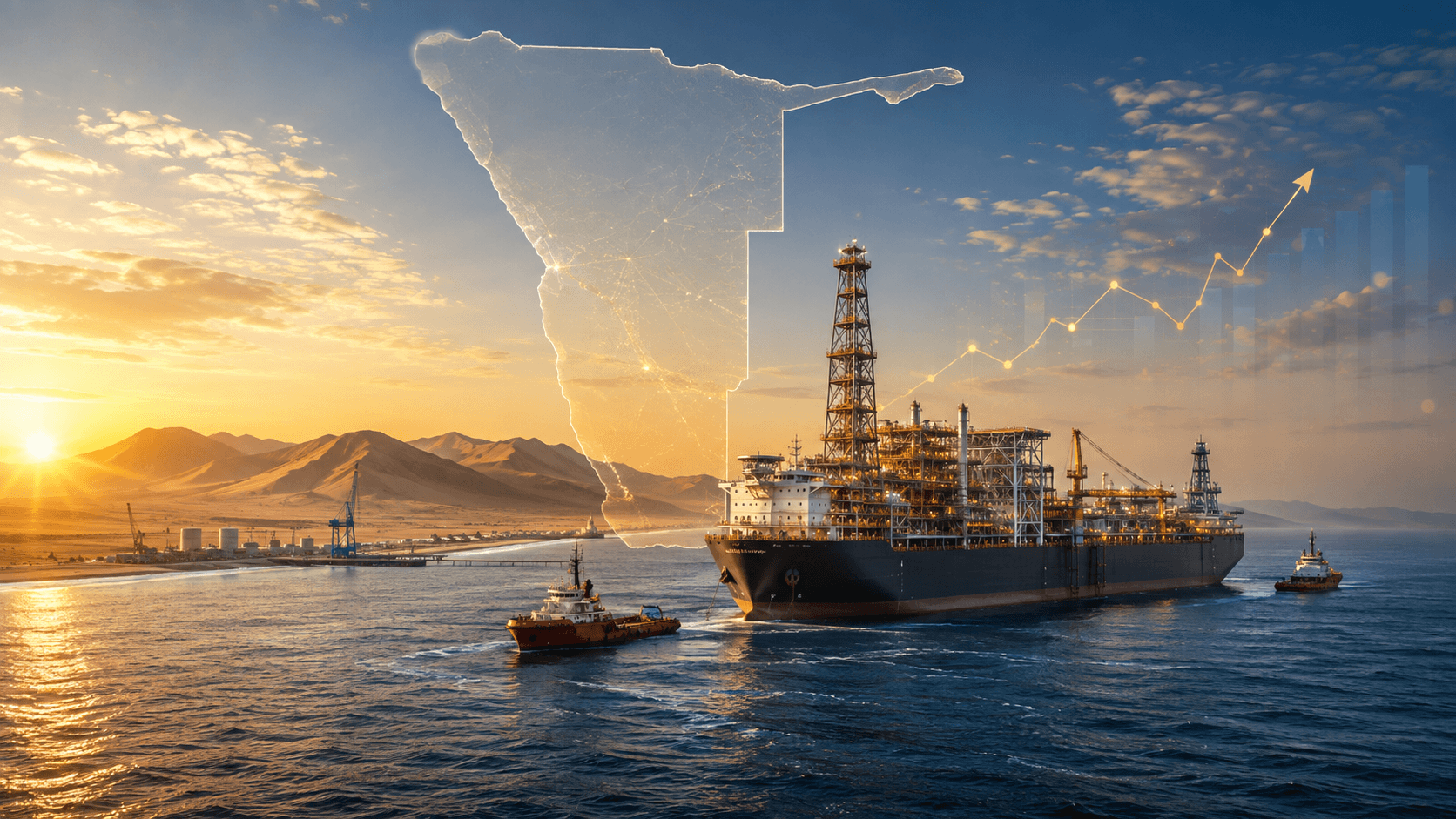
The project is expected to use an offshore Floating Production, Storage and Offloading vessel, commonly known as an FPSO.
What exactly is an FPSO?
An FPSO is essentially a huge floating oil-production facility.
Oil from wells drilled deep beneath the seabed is brought through subsea infrastructure to the FPSO, where the petroleum is processed and stored.
Tankers can then collect the oil directly from the offshore facility and transport it to international markets.
This is particularly useful for a country such as Namibia because the discoveries are in deep water far offshore. Building conventional fixed platforms and pipelines all the way to shore may be considerably more difficult or expensive.
If Venus proceeds according to TotalEnergies' current plans, it is expected to become Namibia's first large FPSO development and could effectively open the Orange Basin as a new producing petroleum region.
So has the final decision already been made?
Not quite.
One of the most important milestones in any oil project is the Final Investment Decision, or FID.
This is the point at which the companies involved formally commit the enormous amounts of capital required to build the project.
During 2026, TotalEnergies and the Namibian government have been negotiating the conditions required to sanction the Venus development.
The company had initially hoped to reach a final decision around mid-2026 and later targeted the end of July. As of early August 2026, the project was still being described publicly as moving towards sanction rather than as a development already in production.
That makes the FID one of the most important events to watch.
Once a positive FID is announced, the question of whether Namibia will become an oil producer becomes significantly less speculative. Attention then shifts towards construction, drilling, installation and the countdown to first oil.
And then there is Mopane
Venus may be the first major development, but it may not be the largest opportunity.
In 2024, Portuguese energy company Galp announced a series of major discoveries at its Mopane prospect in Petroleum Exploration Licence 83.
Mopane quickly became one of the most closely watched oil discoveries anywhere in the world.
In late 2025, Galp selected TotalEnergies as its strategic partner. TotalEnergies acquired a 40% interest in PEL 83 and assumed operatorship, while Galp retained a substantial interest in the licence.
The transaction received the required Namibian competition approval during 2026, leaving TotalEnergies as operator of both the Venus and Mopane discoveries.
TotalEnergies currently estimates Mopane resources at approximately 800 million to 1.1 billion barrels of oil equivalent and has indicated that a development could eventually support production above 200,000 barrels of oil equivalent per day.
Those figures remain subject to further appraisal.
More drilling is planned during 2026 and 2027, with a possible final investment decision around 2028.
If both Venus and Mopane are eventually developed, Namibia could have two major offshore petroleum projects producing during the 2030s.
It is not just Venus and Mopane
The extraordinary level of interest in Namibia comes from the possibility that the country has discovered an entire petroleum province rather than one or two isolated fields.
Other companies continue exploring.
Shell, which made Namibia's first major offshore oil discovery at Graff in 2022, previously wrote down some of its Namibian discoveries after encountering geological and commercial challenges.
However, exploration has continued. In June 2026, Shell described results from another well in PEL 39 as its most promising subsurface results in that licence to date.
Rhino Resources, together with Azule Energy, has also made discoveries. A flow test at its Capricornus discovery produced approximately 11,000 barrels per day during testing.
Rhino has said it is considering a final investment decision around late 2026 or early 2027, with an ambition of reaching production around 2030.
Meanwhile, some of the world's largest energy companies continue acquiring Namibian exploration acreage.
BP entered Namibia as an operator in 2026 through an agreement to acquire interests in offshore Walvis Basin exploration blocks.
TotalEnergies and Petrobras have also expanded into additional Namibian acreage, further demonstrating the international industry's interest in the country's offshore potential.
Could Namibia become a major global oil producer?
Potentially.
But there is an important difference between oil discovered underground and oil that can be economically produced.
Very large resource estimates can sound spectacular, but not every barrel discovered will necessarily be recovered.
Companies have to consider water depth, reservoir characteristics, gas content, drilling costs, infrastructure requirements, global oil prices and the terms agreed with government.
Some Namibian discoveries have already demonstrated this risk. Wells that initially attracted considerable excitement have later been judged commercially challenging.
That is why the number of barrels actually placed into production will matter far more than headline estimates of how much petroleum may exist beneath the seabed.
Nevertheless, Reuters reported in 2026 that Namibia could potentially become a top-15 global oil producer over the coming decade if its major discoveries are successfully developed.
What would oil production mean for Namibia?
The economic implications could be enormous.
A major offshore petroleum industry would attract billions of dollars of investment into an economy that is relatively small by global standards.
That investment could affect construction, logistics, ports, engineering, aviation, accommodation, professional services, training and many other sectors long before the first barrel of oil is sold.
Walvis Bay and Lüderitz could become increasingly important logistics and service centres for offshore operations.
Namibian businesses could potentially supply everything from food and transportation to engineering, legal services, safety equipment, maintenance and specialised offshore support.
But how much of that opportunity remains in Namibia will depend heavily on the country's local-content policies and on whether Namibian businesses and workers can develop the capabilities required by the industry.
Namibia has already developed an upstream petroleum local-content policy aimed at increasing Namibian employment, procurement, skills development and participation in the sector.
How would the government make money from oil?
Oil production does not mean that every dollar earned from selling crude oil belongs to the government.
The companies developing the fields must first recover enormous exploration, construction and operating costs while earning a return on their investment.
Namibia's petroleum fiscal system nevertheless provides several ways for the state to participate in the economic value created.
These include:
- petroleum royalties;
- petroleum income tax;
- additional profits tax;
- licence and rental payments;
- taxes generated by employees and suppliers; and
- returns from participating interests held by NAMCOR where applicable.
Namibia's petroleum fiscal framework currently includes a 5% royalty on petroleum production and 35% petroleum income tax on taxable income, together with an additional profits-tax mechanism that can apply to highly profitable projects.
NAMCOR, Namibia's state-owned national petroleum company, also participates in a number of exploration licences alongside private-sector partners.
Will Namibia suddenly become rich?
This is where expectations need to be managed carefully.
Even if Venus reaches first oil around 2030, Namibia is unlikely to wake up the next morning with billions of dollars available for government spending.
Offshore developments require enormous upfront investments. Taxable profits generally emerge only after allowable costs and project economics are taken into account.
An assessment associated with the Venus project has suggested that significant government revenue could take several years after first oil to materialise fully.
Namibia therefore has time to prepare.
And how the country prepares may ultimately be more important than the discovery itself.
Namibia already has a sovereign wealth fund
One mechanism that could eventually play an important role is the Welwitschia Fund, Namibia's sovereign wealth fund.
The fund was established in 2022 with the objective of strengthening Namibia's resilience to economic shocks while preserving part of the wealth generated from natural resources for future generations.
It is managed by the Bank of Namibia on behalf of government.
If major oil revenues eventually materialise, decisions about how much money should be spent immediately and how much should be saved for future Namibians will become increasingly important.
Will Namibian petrol become cheaper?
Not necessarily.
One of the biggest misconceptions about discovering oil is that it automatically results in cheap petrol and diesel.
Crude oil and petrol are not the same product.
Oil extracted offshore must first be refined into petrol, diesel, jet fuel and other petroleum products.
Unless Namibia develops suitable refining capacity or establishes another arrangement to process its crude domestically, Namibian oil could be exported while the country continues purchasing refined petroleum products through international markets.
Local pump prices would therefore still be influenced by international petroleum prices, refining costs, shipping, exchange rates, taxes, levies and government pricing mechanisms.
Becoming an oil producer does not automatically mean N$10-per-litre petrol.
Oil could create jobs — but perhaps not as many as people expect
Another common misconception is that offshore oil production will directly employ hundreds of thousands of people.
Modern offshore petroleum projects are extremely capital-intensive but relatively specialised.
The direct operation of an FPSO and offshore wells does not require the same number of employees as a similarly valuable labour-intensive industry might.
The larger employment opportunity may therefore come from the supply chain surrounding the industry.
That includes logistics companies, engineers, welders, electricians, technicians, caterers, transport operators, accommodation providers, accountants, lawyers, environmental specialists, software providers and hundreds of other services.
For Namibia, the challenge will be ensuring that these contracts do not simply go to foreign companies that import their own employees and suppliers.
There are also serious risks
Oil wealth is not automatically a guarantee of prosperity.
Around the world, some countries have transformed petroleum resources into excellent infrastructure, savings and higher standards of living.
Others have experienced corruption, excessive government spending, economic dependence on oil and severe inequality.
Economists sometimes refer to part of this problem as the “resource curse”.
A sudden inflow of oil money can also put pressure on other industries, encourage unsustainable spending and make government finances dependent on volatile global oil prices.
Namibia will also need to manage environmental risks.
Offshore drilling and production must coexist with Namibia's fishing industry, marine ecosystems and environmentally important coastline.
That means environmental regulation, emergency preparedness and independent oversight will be just as important as taxation and investment policy.
The next four years could change Namibia
The period between now and 2030 could be one of the most consequential economic periods since independence.
If the Venus project receives a positive final investment decision, billions of dollars could begin flowing into project development before Namibia produces a single commercial barrel.
Mopane could follow.
Rhino Resources could potentially develop another field.
Shell continues exploring.
BP, Petrobras and other international companies are positioning themselves for additional discoveries.
There is no guarantee that every project will succeed.
Oil prices can fall. Wells can disappoint. Costs can rise. Negotiations can stall. Projects can be postponed.
But Namibia is much closer to commercial oil production than it has ever been before.
So, is Namibia about to become an oil-producing nation?
Most likely, yes — if the country's major projects continue progressing as currently planned.
The most realistic target for first major production is currently around 2030, with TotalEnergies' Venus project the leading candidate to produce Namibia's first large volumes of offshore crude.
Mopane and other discoveries could potentially follow during the 2030s, creating an entirely new industry for the country.
But finding oil was only the first challenge.
Namibia's bigger challenge now is deciding what to do with the opportunity.
If the country can attract investment while developing Namibian businesses, training local workers, protecting the environment, managing public revenue responsibly and saving part of that wealth for future generations, oil could reshape Namibia's economy.
If it fails to do those things, some of the largest oil discoveries in Africa could generate far less lasting benefit than Namibians expect.
The story is therefore no longer simply about what lies beneath the Atlantic Ocean.
It is about whether Namibia can turn what lies beneath the ocean into prosperity on land.
This article reflects publicly available information as of August 2026. Offshore petroleum projects involve substantial geological, commercial and regulatory uncertainty. Production estimates, development schedules and resource estimates may change as additional information becomes available.
Key Sources
- TotalEnergies — 2025 Results and 2026 Objectives
- TotalEnergies and Galp — Namibia partnership announcements
- Namibia Ministry of Industries, Mines and Energy — Petroleum Affairs
- NAMCOR — Petroleum legal and fiscal framework
- Bank of Namibia — Welwitschia Sovereign Wealth Fund
- Reuters — Namibia Orange Basin and offshore petroleum reporting
- The Namibian — Venus development and Namibia petroleum-sector reporting
POPULAR ARTICLES
View all