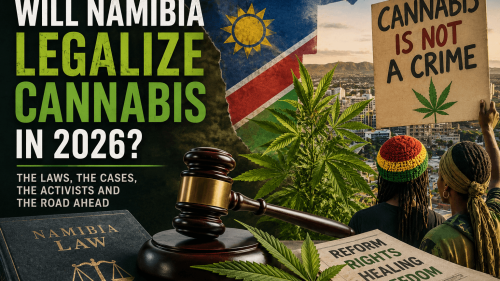

Will Namibia legalize Cannabis in 2026?
For years, the debate around cannabis in Namibia has followed a familiar pattern.
Activists call for legalisation. Police continue making arrests. Court cases drag on. Government promises to consider reform.
But in 2026, something important has changed.
Namibia's government has now formally acknowledged that the country's cannabis laws are under review, while neighbouring South Africa has moved much further towards accepting private cannabis use as part of everyday life.
At the same time, Namibians are still being prosecuted under laws that criminalise cannabis possession, cultivation and dealing.
So could Namibia finally legalise cannabis in 2026?
Probably not before the end of the year — but the debate has arguably moved further into the legal and political mainstream than at any previous point.
Cannabis Is Still Illegal in Namibia
The first thing to understand is that nothing has yet changed for an ordinary cannabis user in Namibia.
Possessing, cultivating or dealing in cannabis can still result in arrest and prosecution under Namibia's drug laws.
There is currently no South African-style exemption allowing adults to simply grow cannabis at home and possess it privately for recreational use.
That remains the case despite years of campaigning from cannabis activists, Rastafarian organisations, medical-use advocates and people who argue that the existing legislation is outdated.
The principal law at the centre of the dispute is the Abuse of Dependence-Producing Substances and Rehabilitation Centres Act of 1971.
The legislation can be viewed through NamibLII .
The Biggest Legal Challenge Came From Ganja Users of Namibia
One of the most important attempts to change Namibia's cannabis laws was launched by Brian Jaftha and Borro Ndungula.
Jaftha is president of Ganja Users of Namibia (GUN) and has also represented the Rastafari United Front, while Ndungula serves as GUN's secretary general.
In 2021, the pair filed a High Court case challenging the constitutionality of Namibia's prohibition on adult cannabis possession and use.
Their case went considerably further than simply asking government to reduce penalties.
They wanted the High Court to declare the prohibition unconstitutional and remove cannabis from legislation criminalising its possession and use.
They also sought relief for people who had previously been prosecuted or convicted for cannabis-related offences.
Jaftha and Ndungula argued that prohibition infringes constitutional rights including privacy, dignity, equality, freedom from discrimination, culture and religion.
The religious argument is particularly important within Namibia's Rastafarian community, where cannabis can form part of spiritual and religious practice.
The case also had a personal dimension.
When their lawsuit was filed in 2021, Jaftha said he was facing cannabis-related charges in two criminal matters, while Ndungula was facing charges in eight.
Background on the original case is available from The Namibian .
Then the High Court Rejected Their Attempt in July 2026
For cannabis supporters, July 2026 initially looked like it could become a landmark moment.
Instead, the High Court declined to overturn Namibia's cannabis laws.
Judge Claudia Claasen ruled that the court should not decide the issue while the government is already engaged in a process of reviewing the country's cannabis legislation.
The ruling is important because the court did not simply conduct a full trial and conclude that cannabis prohibition is constitutionally justified in every respect.
Instead, the judge found that cannabis policy involves interconnected questions of public health, criminal law, social policy, addiction, religious values and economic considerations.
Those issues, she said, are primarily matters for Namibia's executive and Parliament to address through policymaking and legislation.
The government informed the court that the minister of justice had approved a review of cannabis laws by the Law Reform and Development Commission (LRDC).
Because that process is already underway, the court regarded Jaftha and Ndungula's challenge as premature.
Read more: Attempt to Legalise Cannabis Fails in High Court – The Namibian .
That Does Not Mean the Legalisation Campaign Is Over
In some ways, the July judgment moved the cannabis debate away from the courts and directly towards Namibia's politicians.
The question is no longer only whether activists can persuade a judge to invalidate the existing law.
It is now also:
What will the Namibian government do with its own review of cannabis legislation?
The LRDC process could theoretically recommend several different approaches.
Namibia could retain prohibition largely unchanged.
It could decriminalise possession of small quantities without fully legalising cannabis.
It could create exemptions for private adult use.
It could establish a framework for medical cannabis.
It could recognise certain religious uses.
Or it could eventually move towards a broader regulated cannabis market.
At this stage, none of those outcomes is guaranteed.
The Couple Arrested in 2021 Are Still Fighting Their Case
Another case that has become symbolic of Namibia's cannabis debate involves Rastafarian activist Prophet Aldo Timbo and his wife, Empress Tulisa Timbo.
The couple are associated with the Ethiopian African Black International Congress Church Salvation.
They were arrested together on 11 June 2021.
According to police reports cited by the Namibian Broadcasting Corporation, authorities seized approximately 2,167.8 grams — about 2.17 kilograms — of cannabis, which police valued at more than N$100,000.
The couple were accused of unlawfully dealing in a prohibited dependence-producing substance.
Years later, their case remains unresolved.
NBC reported in 2026 that proceedings involving the couple had again been postponed, with another court date expected later in the year.
Aldo Timbo has continued publicly opposing the law.
His argument focuses strongly on religious freedom. He says the continued criminalisation of cannabis prevents Rastafarians from fully practising their religion and treats their community differently from other faith groups.
He has also questioned why alcohol and cigarettes remain legal while Rastafarians can be arrested for possessing a plant they regard as spiritually significant.
More information on the Timbo case is available from NBC News .
Cheryl Green's Arrest Put Medical Cannabis Into the Spotlight
Another important case dates back to 2019.
Swakopmund resident and herbalist Cheryl Green was arrested after police found 71 cannabis plants, as well as cannabis oil and seeds, at her home.
Green said she was growing the plants to produce cannabis oil for her partner, Rainer Kring, who was suffering from a serious motor-neuron condition.
She repeatedly denied being a conventional drug dealer and said the cannabis was being used medicinally.
The case became particularly controversial because it forced courts and police to confront questions about the distinction between cannabis, hemp, THC and products cultivated for alleged medical purposes.
Green pleaded not guilty to charges involving possession and dealing.
Background on her case can be found in The Namibian's original 2019 report .
Green also became involved in cannabis reform advocacy through the Cannabis and Hemp Association of Namibia.
Her case helped demonstrate that the legalisation debate is not only about recreational users. Medical cannabis, hemp production and access to alternative treatments have all become part of the discussion.
She Was Not the Only Medical-Use Arrest
Around the same period, Henties Bay resident Thillo Tietz was also arrested after police found four cannabis plants at his home.
He too said the plants were intended for producing cannabis oil rather than ordinary recreational dealing.
The two coastal arrests attracted attention because they raised a difficult question:
If someone grows cannabis to produce oil for themselves or a sick family member, should the criminal law treat that person in the same way as a commercial drug dealer?
Under Namibia's existing system, cannabis cultivation remains capable of attracting criminal prosecution regardless of whether the person involved considers the purpose medicinal.
Who Is Fighting to Legalise Cannabis in Namibia?
There is no single organisation behind the legalisation movement.
The most prominent voices have included:
- Ganja Users of Namibia (GUN), led by figures including Brian Jaftha and Borro Ndungula;
- the Rastafari United Front and members of Namibia's wider Rastafarian community;
- Brian Jaftha, who has pursued legal reform through the High Court;
- Borro Ndungula, who has been involved in both activism and litigation;
- Prophet Aldo Timbo, who argues strongly for religious rights and cannabis reform;
- Cheryl Green and cannabis/hemp advocates who have promoted medical and industrial uses; and
- lawyers and civil-rights advocates challenging whether the existing prohibition remains constitutionally defensible.
Lawyer Kadhila Amoomo has represented Jaftha and Ndungula in their constitutional challenge and has publicly criticised delays in dealing with cannabis reform.
Then There Is South Africa
Namibia's cannabis debate becomes particularly interesting when compared with its southern neighbour.
Cross the border into South Africa and the legal position is dramatically different.
South Africa's Constitutional Court ruled in 2018 that criminalising an adult's private possession and use of cannabis violated the constitutional right to privacy.
That meant adults could no longer be criminally prosecuted simply for possessing or using cannabis privately.
The legal framework was developed further when President Cyril Ramaphosa signed the Cannabis for Private Purposes Act in May 2024.
The Act is available from the South African Government .
The legislation is designed to regulate the cultivation, possession and use of cannabis by adults in private.
But South Africa Has Not Simply Legalised Everything
There is an important misconception about South Africa.
Private cannabis use is legal for adults, but South Africa does not yet have a completely open recreational cannabis market where anyone can legally open a shop and sell marijuana like alcohol.
Commercial trade remains heavily restricted.
South Africa's Parliament acknowledged this distinction in March 2026, noting that while adult private use is legal, commercial cannabis trade remains largely prohibited.
Government is still developing the wider framework required to regulate commercial cultivation, manufacturing, health standards and sales.
Yet Cannabis Has Become Much More Normalised in South Africa
Even without a fully legal commercial market, cannabis has become considerably more visible and socially normalised in South Africa since the Constitutional Court's 2018 decision.
Private cultivation no longer carries the same criminal risk for adults when it falls within the protected private-use framework.
There is a growing cannabis industry involving hemp, medical products, cultivation technology, research and businesses attempting to position themselves for eventual commercial reform.
The scale of cannabis consumption is also difficult to ignore.
In March 2026, South Africa's Parliament was told that estimates placed the country's illicit cannabis market at approximately R36 billion.
That does not mean all cannabis transactions in South Africa are legal. Quite the opposite: Parliament specifically noted that restrictions on commercial trade have left much of the market operating outside the formal legal system.
But it does illustrate the enormous scale of cannabis use and economic activity surrounding the plant.
Read the parliamentary statement: Parliament of South Africa – Progress Towards Cannabis Regulation .
South Africa Is Still Changing Its Rules in 2026
South Africa's cannabis experiment is itself unfinished.
In February 2026, its Department of Justice released draft regulations dealing with the quantities of cannabis adults may possess or cultivate for private purposes.
The country is also working towards a broader cannabis framework addressing commercialisation.
That makes South Africa useful for Namibia not necessarily as a model to copy exactly, but as a real-world example of what happens after private cannabis use is decriminalised.
Namibian lawmakers can now observe the consequences next door — both the opportunities and the regulatory problems.
The Economic Argument Is Becoming Harder to Ignore
Cannabis reform is also increasingly an economic discussion.
Supporters argue that legal cultivation could create opportunities in:
- commercial agriculture;
- industrial hemp;
- textiles;
- construction materials;
- cosmetics;
- medical products;
- research;
- processing and manufacturing; and
- eventual regulated cannabis tourism or retail, depending on the law.
For a country continually searching for new agricultural industries and employment opportunities, those arguments are likely to receive increasing attention.
But economic potential alone does not settle the debate.
Why Government May Still Be Cautious
The High Court's July 2026 judgment highlighted precisely why cannabis reform is complicated.
Government must consider not only personal freedom but also public health, dependence and problematic use, policing, road safety, children, workplace rules, commercial regulation and the social cost of substance abuse.
Legalising cannabis does not remove those problems.
It changes how government chooses to manage them.
That distinction is important.
The real policy choice is not necessarily between "cannabis exists" and "cannabis does not exist". Cannabis already exists in Namibia and people are already arrested for possessing and selling it.
The debate is increasingly about whether criminal prohibition is the most effective way to regulate that reality.
Legalisation and Decriminalisation Are Not the Same Thing
Namibia could also reform its laws without immediately creating a legal recreational cannabis industry.
Decriminalisation could mean that possessing a small quantity for personal use no longer results in a criminal prosecution, while commercial selling remains illegal.
Legalisation could go further by establishing rules under which cultivation, possession, production or sale is legally permitted and regulated.
Medical legalisation could create a narrower system allowing cannabis-based treatments under specified medical rules while recreational possession remains prohibited.
South Africa itself demonstrates that these reforms often happen in stages rather than through one dramatic decision.
So, Will Namibia Legalize Cannabis in 2026?
Based on where the process stands in August 2026, a complete legalisation framework before the end of the year appears unlikely.
There is currently no publicly enacted Namibian law creating a South African-style right for adults to cultivate and possess cannabis privately.
The High Court has also declined to create that right judicially while the government's reform process is underway.
But that should not be confused with the issue being dead.
For the first time, the government's own legislative-review process has become a central reason why the court declined to intervene.
That makes the Law Reform and Development Commission one of the most important institutions to watch next.
If the LRDC recommends significant reform and government accepts those recommendations, Namibia could eventually move towards decriminalisation or legalisation through Parliament.
The critical question is whether that process produces actual legislation — and how quickly.
Namibia Is Now Faced With a Choice
For decades, Namibia's approach has effectively been straightforward: cannabis is prohibited, and people caught possessing, growing or dealing in it can be arrested.
That system is now under increasing pressure.
Activists are challenging it constitutionally.
Rastafarians are challenging it on religious grounds.
Medical-use advocates question why patients and caregivers should face criminal prosecution.
Agricultural and business advocates see potential economic opportunities.
And directly across Namibia's southern border, millions of South Africans live under a system where adult private cannabis use is no longer, by itself, a criminal offence.
Meanwhile, Namibians such as Aldo and Tulisa Timbo can spend years moving through the courts over cannabis charges.
That contrast will become increasingly difficult for policymakers to ignore.
The question facing Namibia is therefore no longer simply whether cannabis is good or bad.
It is whether a criminal prohibition written in another era remains the best system for dealing with cannabis in modern Namibia.
2026 may not be the year cannabis becomes legal in Namibia. But it could prove to be the year the country finally starts deciding what should replace the old approach.
This article reflects the legal and policy position available as of August 2026. Cannabis remains prohibited in Namibia. Anyone facing a cannabis-related legal issue should obtain advice on the current law rather than relying on developments in neighbouring South Africa.
Sources and Further Reading
- The Namibian – Attempt to Legalise Cannabis Fails in High Court
- The Namibian – Lawsuit Filed to Legalise Dagga
- NBC News – Aldo and Tulisa Timbo Cannabis Case
- The Namibian – Cheryl Green: "I Am a Healer, Not a Dealer"
- NamibLII – Abuse of Dependence-Producing Substances and Rehabilitation Centres Act
- South African Government – Cannabis for Private Purposes Act 7 of 2024
- Parliament of South Africa – Cannabis Regulation and Commercialisation Update, March 2026
POPULAR ARTICLES
View all