
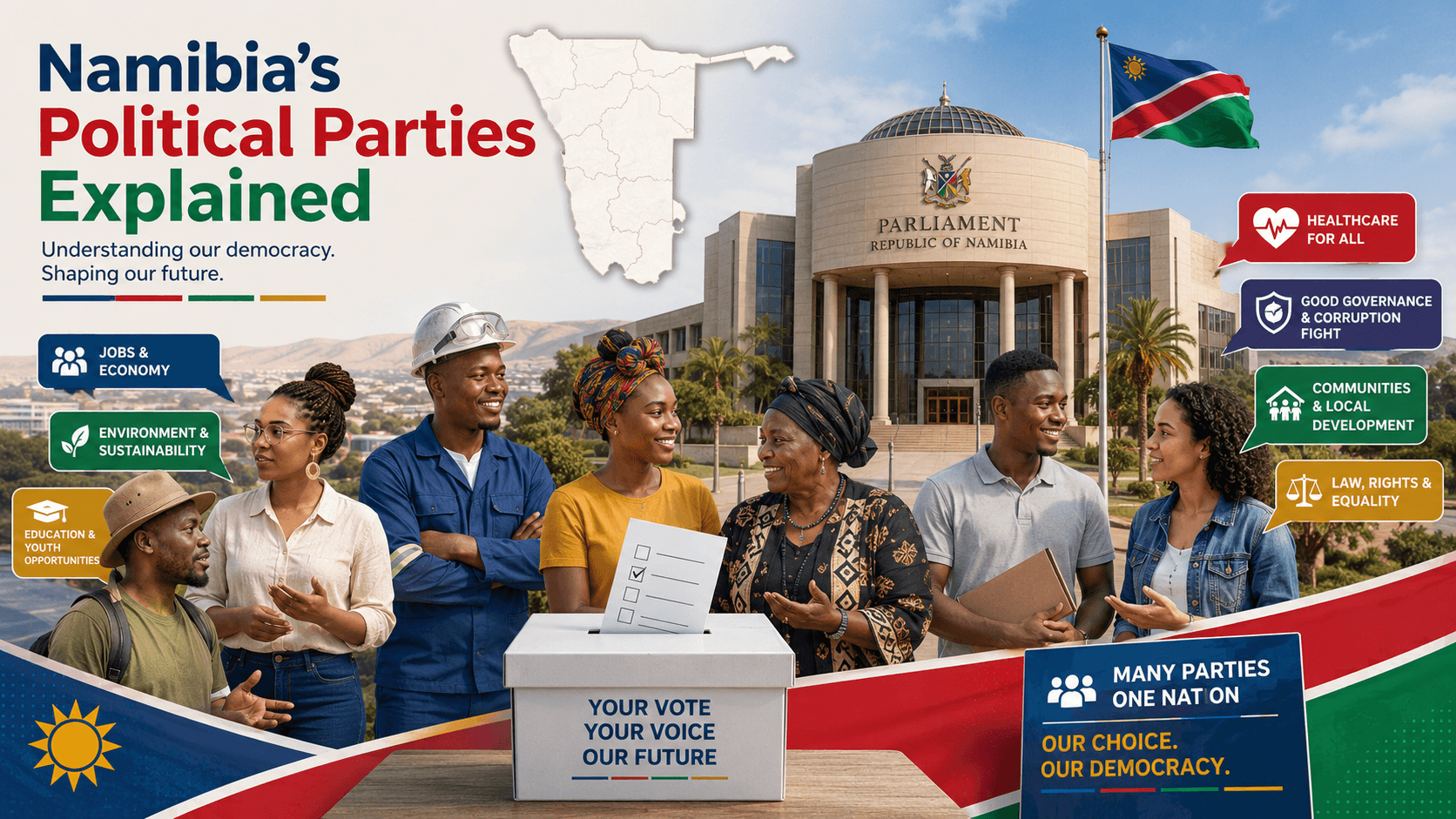
Namibia’s Political Parties Explained
Namibia has far more political parties than just SWAPO and the official opposition. From liberation movements and land-reform activists to Christian parties, social democrats and newer anti-establishment movements, the country's political landscape has become increasingly diverse.
Since independence in 1990, Namibian politics has been dominated by one name: SWAPO.
But that does not mean Namibia is a one-party state.
The country has a competitive multi-party electoral system, and the Electoral Commission of Namibia (ECN) currently lists 25 registered political parties.
Thirteen parties are represented in the current National Assembly, ranging from SWAPO with 51 elected seats to several smaller parties with a single representative.
The political landscape also changed substantially after the 2024 election.
The Independent Patriots for Change (IPC) replaced the Popular Democratic Movement as the largest opposition party, while the newly registered Affirmative Repositioning (AR) entered Parliament with six seats on its first attempt.
So who are all these parties, where did they come from, and what do they actually stand for?
Here's a guide to Namibia's political parties as the country enters the second half of the 2020s.
First, how does Namibia's political system work?
Namibia is a constitutional democracy with a directly elected President and a bicameral Parliament consisting of the National Assembly and National Council.
The President is elected separately from the National Assembly.
This means a Namibian voter effectively makes two different national choices:
- one vote for a presidential candidate; and
- one vote for a political party to represent them in the National Assembly.
The National Assembly has 96 elected voting members.
The President may additionally appoint up to eight non-voting members based on their expertise, experience or other qualifications.
Parliamentary seats are allocated broadly in proportion to the share of the national vote received by each political party.
This is why even parties receiving around one percent of the national vote can sometimes secure a seat in Parliament.
More information about the current National Assembly is available from the Parliament of Namibia.
What happened in the 2024 election?
Namibia held its most recent Presidential and National Assembly elections in November 2024.
SWAPO presidential candidate Netumbo Nandi-Ndaitwah won the presidency with approximately 58% of the presidential vote and was inaugurated on 21 March 2025 as Namibia's first female President.
In the National Assembly election, SWAPO received 583,300 votes and secured 51 of the 96 elected seats.
The IPC finished second with 20 seats, becoming Namibia's largest opposition party.
The broad allocation of elected National Assembly seats following the election was:
| Party | Seats |
|---|---|
| SWAPO Party of Namibia | 51 |
| Independent Patriots for Change (IPC) | 20 |
| Affirmative Repositioning (AR) | 6 |
| Popular Democratic Movement (PDM) | 5 |
| Landless People's Movement (LPM) | 5 |
| United Democratic Front (UDF) | 2 |
| All People's Party (APP) | 1 |
| Body of Christ Party (BCP) | 1 |
| National Democratic Party (NDP) | 1 |
| Namibia Economic Freedom Fighters (NEFF) | 1 |
| National Unity Democratic Organisation (NUDO) | 1 |
| Republican Party (RP) | 1 |
| SWANU of Namibia | 1 |
The official results can be viewed through the Electoral Commission of Namibia.
1. SWAPO Party of Namibia
Seats in the National Assembly: 51
SWAPO is by far the most important political organisation in Namibia's post-independence history.
It emerged from the liberation struggle against South African rule and became internationally recognised as a leading representative of the Namibian independence movement.
SWAPO has governed Namibia continuously since independence in 1990.
Namibia's first President, Sam Nujoma, was SWAPO's leader, as were his successors Hifikepunye Pohamba, Hage Geingob and current President Netumbo Nandi-Ndaitwah.
President Nandi-Ndaitwah is also the current President of the SWAPO Party.
SWAPO's political identity combines its liberation-movement history with a broad developmental and social-welfare approach to government.
Its 2024 election manifesto placed substantial emphasis on:
- job creation;
- youth empowerment;
- industrialisation;
- agriculture;
- infrastructure;
- housing;
- natural-resource beneficiation; and
- increasing the economic benefit Namibians receive from the country's resources.
SWAPO's greatest political advantage remains its enormous national organisation and historical connection to Namibia's independence.
Its challenge is that an increasing number of younger voters judge the party less on the liberation struggle and more on current issues such as unemployment, housing, inequality, corruption and service delivery.
The 2024 result illustrated both realities.
SWAPO still won a clear majority — but opposition parties collectively attracted a substantial share of the electorate.
2. Independent Patriots for Change (IPC)
Seats in the National Assembly: 20
Party President: Dr Panduleni Itula
The IPC is the largest opposition party in the current National Assembly.
It is also remarkably young.
The party was established in 2020 following the political rise of Dr Panduleni Itula, who had challenged the 2019 presidential election as an independent candidate.
IPC describes its core principles as including:
- integrity;
- accountability;
- anti-corruption;
- the rule of law;
- evidence-based economic policy;
- inclusive governance;
- youth empowerment; and
- effective public-service delivery.
The party positions itself strongly against what it regards as corruption, institutional decline and excessive political control over government institutions.
IPC's rise has been unusually fast by Namibian political standards.
In the 2024 National Assembly election, it received more than 220,000 votes, securing 20 seats and replacing the PDM as the country's largest parliamentary opposition force.
You can read more about its stated policies on the official IPC website.
3. Affirmative Repositioning (AR)
Seats in the National Assembly: 6
Leader: Prof. Job Shipululo Amupanda
Affirmative Repositioning is one of the most unusual political organisations in Namibia because it began not as a conventional political party but as an activist movement.
AR emerged in 2014 and became particularly well known through campaigns around urban land and housing.
The movement subsequently formalised its structures and was registered to participate in the 2024 national elections.
Its first election was remarkably successful: AR won more than 72,000 National Assembly votes and entered Parliament with six seats.
AR openly describes itself in its 2024 manifesto as a revolutionary force of the left.
Its policy platform includes:
- large-scale housing intervention;
- land reform;
- greater state participation in economic development;
- stronger worker protections;
- greater Namibian control over natural resources;
- free tertiary education;
- youth employment programmes;
- constitutional reforms;
- greater recognition of indigenous languages; and
- reforming public enterprises.
Among AR's more unusual 2024 proposals was the development of a plan to potentially delink the Namibia Dollar from the South African Rand.
Its emergence has added a younger and more explicitly left-wing voice to Parliament.
AR's 2024 manifesto can be accessed through Namibia Fact Check's manifesto collection.
4. Popular Democratic Movement (PDM)
Seats in the National Assembly: 5
Party President: McHenry Venaani
The Popular Democratic Movement is one of Namibia's oldest major opposition formations.
Older Namibians may remember it by its former name: the Democratic Turnhalle Alliance, or DTA.
The party was renamed the Popular Democratic Movement in 2017 as part of an effort to modernise its identity and move beyond the political baggage associated with the DTA era.
The PDM has generally presented itself as a broad democratic opposition party focused on issues such as:
- employment;
- economic growth;
- education;
- healthcare;
- housing;
- agriculture;
- accountable government; and
- stronger institutions.
PDM enjoyed a particularly strong election in 2019, when it became the official opposition with 16 seats.
The 2024 election was considerably more difficult.
It fell to five seats as IPC and AR captured much of the anti-SWAPO vote.
PDM nevertheless remains an established national party with a long parliamentary history.
5. Landless People's Movement (LPM)
Seats in the National Assembly: 5
Leader: Bernadus Swartbooi
The Landless People's Movement grew out of disputes surrounding land reform and resettlement.
Its leader, Bernadus Swartbooi, previously served as a SWAPO deputy minister before leaving government following a conflict over land policy.
Unsurprisingly, land remains central to LPM's political identity.
Its 2024 manifesto describes the movement's struggle in terms of restorative justice relating to land, housing and propertylessness.
LPM also campaigns on:
- housing;
- local government reform;
- youth empowerment;
- economic justice;
- natural resources;
- decentralisation; and
- stronger accountability in government.
LPM has developed particularly visible political support in parts of southern Namibia, although it contests elections nationally.
It retained five seats in the 2024 National Assembly election.
6. United Democratic Front of Namibia (UDF)
Seats in the National Assembly: 2
The United Democratic Front is another long-established Namibian political organisation.
Its 2024 manifesto explicitly describes its political programme as social democratic.
The party places considerable emphasis on decentralising government so that regions and local authorities have greater control over development.
Other UDF policies in its 2024 manifesto included:
- industrialisation and job creation;
- affordable housing;
- expanded vocational training;
- greater Namibian participation in mining and other natural-resource sectors;
- greater state control over strategic natural-resource extraction;
- support for SMEs;
- agricultural investment;
- a basic income grant for unemployed adults; and
- greater regional decentralisation.
The UDF secured two seats in the 2024 election.
7. National Unity Democratic Organisation (NUDO)
Seats in the National Assembly: 1
NUDO has a long political history and was previously associated with the broader DTA alliance before becoming an independent political party.
Historically, the party has had particularly strong roots within sections of the Otjiherero-speaking community, although it contests elections as a national political organisation.
NUDO has traditionally emphasised:
- land reform;
- social welfare;
- economic inclusion;
- traditional communities;
- restorative justice; and
- decentralisation.
NUDO secured one National Assembly seat in the 2024 election.
8. SWANU of Namibia
Seats in the National Assembly: 1
SWANU occupies a particularly important place in Namibian political history.
It was founded in 1959, making it older than SWAPO.
SWANU participated in the anti-colonial struggle but eventually developed separately from SWAPO.
The party has historically been associated with left-wing, Pan-African and socialist political traditions.
In contemporary politics it continues to campaign around economic inequality, land, labour, education and greater national control over Namibia's resources.
SWANU currently holds one seat in the National Assembly.
9. Namibia Economic Freedom Fighters (NEFF)
Seats in the National Assembly: 1
NEFF represents a more radical economic-nationalist strand of Namibian opposition politics.
The movement frequently focuses on worker rights, economic inequality, foreign ownership, natural resources and greater economic participation by Namibians.
It also had one of the more unusual journeys into the 2024 election.
The Electoral Commission deregistered NEFF in June 2024 over financial-reporting compliance issues.
NEFF challenged the decision in court, and the party was ultimately reinstated after the court found that the deregistration process had not complied with the required procedural standards.
It subsequently participated in the national election and won one seat.
NEFF remains represented in the current National Assembly.
10. All People's Party (APP)
Seats in the National Assembly: 1
The All People's Party is a smaller national opposition party currently led by Ambrosius Kumbwa.
The party has historically focused on issues including rural development, public services, employment and accountable government.
APP received 7,219 votes in the 2024 National Assembly election, enough to retain parliamentary representation with one seat.
11. National Democratic Party of Namibia (NDP)
Seats in the National Assembly: 1
The National Democratic Party is led by Martin Lukato Lukato.
The party has particularly strong historical roots in the Zambezi Region and has participated in Namibian elections for many years.
In the 2024 National Assembly election, the NDP received 6,647 votes and secured one seat.
Lukato represents the party in the current National Assembly.
12. Body of Christ Party (BCP)
Seats in the National Assembly: 1
The Body of Christ Party is one of Namibia's explicitly faith-based political parties.
It is led by Bishop Festus Thomas and approaches politics from an openly Christian perspective.
BCP received 5,763 National Assembly votes in 2024 and secured one parliamentary seat.
It is an example of how Namibia's proportional electoral system can allow relatively small political movements to gain representation at national level.
13. Republican Party of Namibia (RP)
Seats in the National Assembly: 1
The Republican Party is one of Namibia's older political organisations and has roots in the pre-independence DTA political tradition.
It later separated from the DTA and re-established itself as an independent party.
The ECN currently lists Henry "Henk" Mudge as the party's president, while Mathias Mbundu currently represents the party's leadership in the National Assembly.
RP received 10,942 votes in the 2024 National Assembly election and secured one seat.
What about the political parties that are not in Parliament?
Winning no National Assembly seats does not mean a political party has ceased to exist.
According to the Electoral Commission of Namibia, there are currently 25 registered political parties.
In addition to the parties represented in the National Assembly, the ECN currently lists parties including:
- Action Democratic Movement Party (ADM)
- Christian Democratic Voice Party (CDV)
- Congress of Democrats (CoD)
- Monitor Action Group (MAG)
- Namibia Progressive Party (NAPPA)
- National Empowerment Fighting Corruption (NEFC)
- National Patriotic Front of Namibia (NPF)
- People United for Change (PUC)
- Rally for Democracy and Progress (RDP)
- United Namibians Party (UNP)
- United People's Movement (UPM)
- Workers Revolutionary Party (WRP)
Some of these parties have previously held parliamentary seats.
The Congress of Democrats, for example, was once Namibia's official opposition.
The Rally for Democracy and Progress also emerged as a significant opposition force after being formed by former senior SWAPO figures.
Electoral fortunes can change quickly, and a party that has no National Assembly representation today could still hold regional or local authority representation or return to Parliament in a future election.
Namibian politics doesn't fit neatly into "left" and "right"
One mistake when discussing Namibia's parties is trying to force every organisation into the traditional European or American left-versus-right political spectrum.
There are ideological differences, but Namibian politics is also shaped by factors including:
- the liberation struggle;
- land ownership;
- regional identities;
- traditional communities;
- inequality;
- youth unemployment;
- urban housing;
- natural-resource ownership;
- corruption and governance;
- religion; and
- the relationship between the state and private enterprise.
Parties can also combine policies that would be considered "left-wing" in one country with socially or economically conservative positions on other issues.
It is therefore often more useful to examine what a Namibian party proposes on individual issues than to simply attach a left, centre or right label to it.
The biggest political dividing line is increasingly generational
For much of Namibia's post-independence history, the liberation struggle was one of the most important factors shaping electoral loyalty.
That remains important.
But an increasingly large part of the electorate was born after independence or was too young to remember the events leading to 1990.
These voters are more likely to evaluate political parties on immediate questions such as:
- Can I find a job?
- Can I afford a house?
- Can I obtain land?
- Are government services working?
- Is corruption being addressed?
- Will Namibia's oil and mineral wealth benefit me?
- Can I start and grow a business?
- Is education preparing people for the economy?
This helps explain the emergence of newer political formations such as IPC, AR and LPM.
Their political appeal is generally based less on liberation credentials and more on the argument that Namibia needs a different approach to governing the country today.
Why does Namibia have so many small parties?
Namibia's proportional-representation electoral system makes it possible for a relatively small political party to gain a seat in the National Assembly.
A party does not need to win an entire geographic constituency to enter the Assembly.
Instead, its national vote total contributes towards the allocation of seats.
This creates opportunities for smaller ideological, regional or issue-focused political movements to gain national representation.
The downside is fragmentation.
Opposition votes can be divided among numerous parties, making it difficult for any single opposition organisation to challenge a dominant governing party.
The rise of IPC has changed that dynamic somewhat by creating a significantly larger opposition bloc than most of the smaller parties can individually provide.
SWAPO still dominates — but the political landscape is changing
The simplest description of Namibian politics remains:
SWAPO governs, while a fragmented collection of opposition parties competes to challenge it.
But that description is becoming less complete.
IPC now holds 20 seats.
AR entered Parliament with six seats in its first national election.
LPM has established itself as a durable opposition force.
PDM remains a significant historic party despite its weaker 2024 result.
And a collection of smaller parties ensures that voices ranging from social democrats and Christian movements to economic nationalists and land activists are represented in Parliament.
Meanwhile, SWAPO's support is no longer at the overwhelming levels it enjoyed at the height of its post-independence dominance.
That makes the next decade of Namibian politics particularly interesting.
What should voters actually look at?
Party colours and campaign rallies tell you very little about what a political organisation would actually do in government.
Before an election, voters should ideally look at:
- the party's manifesto;
- its voting record in Parliament;
- how its councillors perform in local and regional government;
- the quality of candidates on its party list;
- its financial and organisational transparency;
- whether its promises are financially realistic;
- how it responds when its own members are accused of wrongdoing; and
- whether its policies are actually consistent from one election to the next.
Campaign promises are easy.
Governing is not.
Where can you find the political parties' manifestos?
One useful resource is Namibia Fact Check's collection of 2024 election manifestos.
It includes manifestos from parties such as:
- SWAPO
- IPC
- PDM
- LPM
- AR
- NUDO
- SWANU
- UDF
- NEFF
- RP
- NDP
- NEFC
- BCP
For official information about registered parties, candidates and election results, use the Electoral Commission of Namibia.
Namibia's democracy is bigger than any one party
SWAPO's role in Namibia's independence and post-independence history is enormous.
But modern Namibia's political system now includes organisations that emerged from very different periods and very different concerns.
SWANU predates SWAPO.
PDM traces its history back to the DTA era.
NUDO and UDF represent longstanding strands of Namibian opposition politics.
LPM emerged from disputes over land.
IPC grew rapidly around demands for political change, accountability and institutional reform.
AR grew from youth activism and the struggle for urban land into the third-largest opposition bloc in Parliament.
And several smaller parties continue to represent more specific political, regional, economic or religious perspectives.
Understanding these parties matters because Namibian politics is no longer simply a question of being for or against SWAPO.
Increasingly, the debate is about what kind of government, economy and society Namibia should build next.
Twenty-five registered parties may be a lot for a country of around three million people — but they also demonstrate just how many different answers Namibians have to that question.
Useful Links and Sources
- Electoral Commission of Namibia — Registered Political Parties
- Electoral Commission of Namibia — Elections and Results
- Parliament of Namibia — Political Parties in the National Assembly
- Parliament of Namibia — National Assembly
- Namibia Fact Check — 2024 Political Party Manifestos
- Independent Patriots for Change — Official Website
- SWANU of Namibia — Official Website
Editorial note: This article reflects the political-party landscape and publicly available information as of August 2026. Party leadership, parliamentary membership and policy positions can change. Descriptions of political positions are intended as broad summaries rather than endorsements or criticisms of any party. For official party-registration and election information, consult the Electoral Commission of Namibia.
POPULAR ARTICLES
View all