
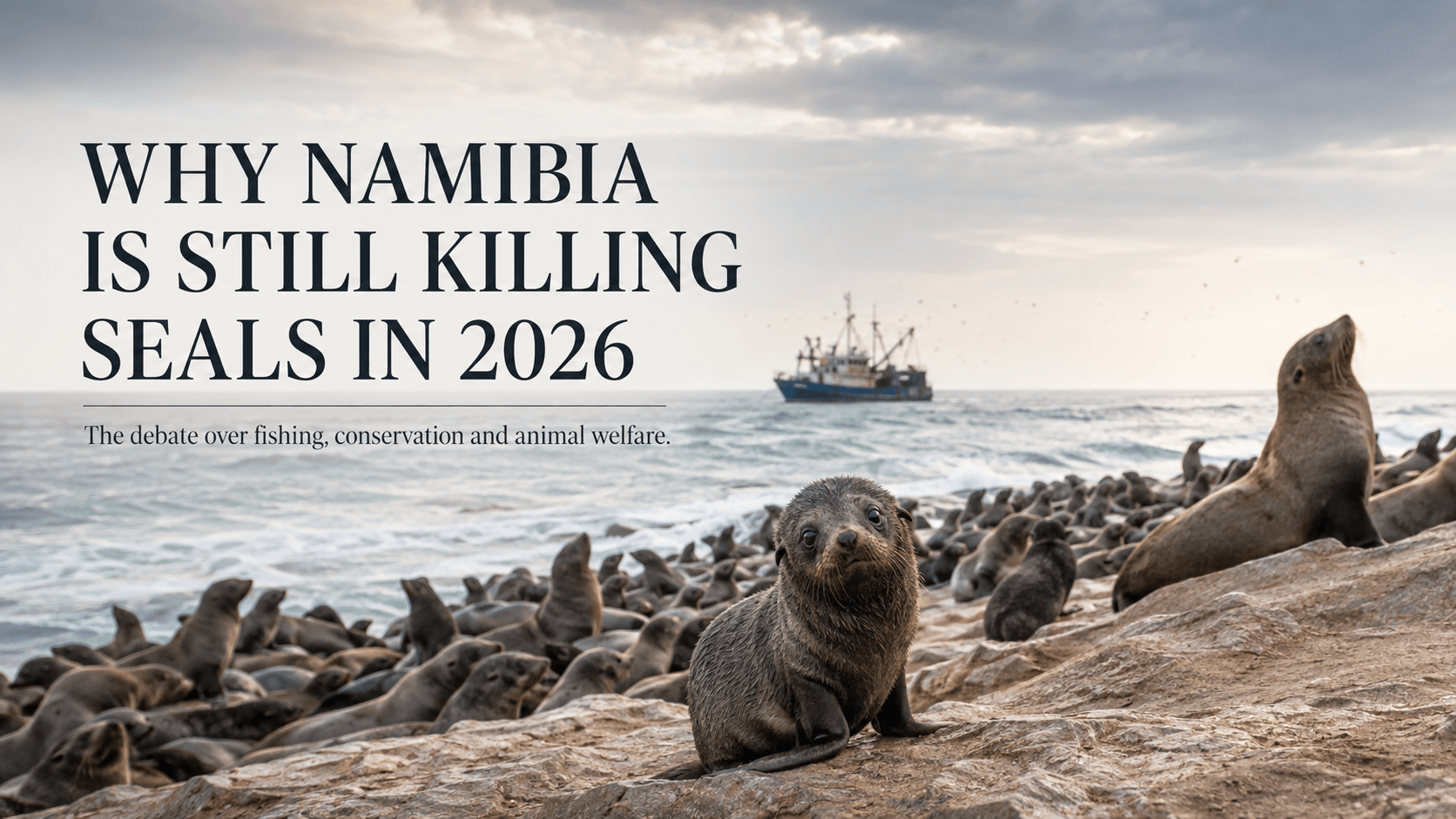
Why Namibia Is Still Killing Seals in 2026
Every year, tens of thousands of Cape fur seals can legally be allocated for commercial harvesting along Namibia's Atlantic coast.
To the Namibian government and parts of the fishing industry, the practice is presented as wildlife management and sustainable use of a natural resource. To animal-welfare campaigners, it is something very different: the killing of young seals with clubs is regarded as cruel, unnecessary and, for many people who encounter images of it, simply horrifying.
In 2026, the controversy is far from settled.
Namibia has not moved towards banning its commercial seal harvest. In fact, recent government initiatives have focused on making the seal industry more economically viable, finding markets for seal products and improving processing.
At the same time, Namibia's own parliamentary investigation has acknowledged that the argument often used to justify the practice — that seals are responsible for declining commercial fish stocks — is considerably more complicated than it appears.
So why does Namibia still kill seals?
Namibia's Cape Fur Seal Population Is Enormous
The Cape fur seal is one of the most familiar animals along Namibia's coast.
Large colonies occur between Lüderitz and northern coastal areas, with Cape Cross being the best-known. Namibia's Ministry of Environment describes the Cape Cross Seal Reserve as home to one of the world's largest breeding colonies, with as many as approximately 210,000 seals present during the breeding season.
Read more about the Cape Cross Seal Reserve .
The national population is much larger.
A 2025 parliamentary investigation reported an estimated population of around 1.6 million Cape fur seals, compared with approximately 680,000 in 1970. The committee also recorded around 26 seal colonies along Namibia's coastline.
Read Parliament's report on seals .
That growth is one of the central arguments used by supporters of seal harvesting.
The concern is that a large seal population consumes enormous quantities of marine life and increasingly interacts with commercial fishing operations.
The Government Calls It a "Harvest"
The terminology surrounding the practice is itself controversial.
Namibian authorities generally refer to it as seal harvesting, placing it within the country's broader philosophy of sustainable utilisation of natural resources.
Critics are more likely to call it a seal hunt, cull or slaughter.
Whatever terminology is used, animals are deliberately killed for commercial purposes.
The Ministry of Environment states that sustainable seal harvesting takes place annually at Cape Cross under the authority of the fisheries ministry, which determines how many animals may be taken.
Historically, the harvesting season has run from 1 July until 15 November. Namibia's 2025 parliamentary report confirmed that timetable, although the committee recommended considering a longer season.
Yes, Young Seals Are Still Clubbed
This is the part of Namibia's seal industry that attracts the strongest international criticism.
Young Cape fur seals are traditionally killed by being struck on the head with clubs or similar implements. Adult bulls are generally shot.
Ocean Conservation Namibia, one of the country's most visible seal conservation organisations, describes pups being killed by blows to the head while adult bulls are shot.
Namibia's own parliamentary investigation also directly addressed the controversy surrounding clubbing. During its consultations, industry representatives suggested that alternative harvesting methods should be explored because clubbing is viewed by animal-rights organisations as cruel and inhumane.
For people opposed to the practice, this is often where debates about population statistics and fisheries management become secondary.
Cape fur seal pups are highly visible, social animals. Images of young seals being chased and struck with clubs are deeply disturbing to many people, including Namibians who may otherwise support the sustainable use of wildlife.
That emotional response should not be dismissed simply because Namibia has an economic or ecological argument for managing wildlife.
But neither does finding the practice horrible, by itself, answer the scientific question of whether some form of population management is justified.
Those are two different questions.
The Fishing Industry Says Seals Cost It Money
To understand why the practice survives, it is necessary to understand the relationship between seals and Namibia's fishing industry.
Cape fur seals eat fish.
They also learn quickly that fishing vessels provide opportunities for relatively easy meals.
Seals can approach fishing boats and remove fish from lines, interfere with fishing operations and become entangled in fishing gear.
Namibia's parliamentary investigation heard complaints from fishing businesses that seals scatter shoals, reduce catches and damage fishing equipment. Longline operators in particular described seals directly taking fish from fishing lines and increasing operating costs.
This is not merely theoretical.
The Marine Stewardship Council reported in 2026 that Namibia's hake industry continues to experience interactions between fishing vessels and Cape fur seals. Seals may take fish from fishing gear and can themselves become caught in lines, nets and discarded equipment.
For a fishing company, therefore, a seal is not necessarily the charming animal a tourist photographs at Cape Cross.
It can be a competitor.
And that is where the idea that Namibia has "too many seals" becomes politically powerful.
But Are Seals Really Destroying Namibia's Fish Stocks?
This is where the argument becomes much less straightforward.
Namibia's 2025 parliamentary investigation produced findings that could be used by both sides of the debate.
The committee acknowledged the very large seal population and recognised the impact seals can have on particular fishing operations.
But it also found that the available scientific evidence does not support simply blaming seals for the depletion of commercial fish stocks.
One particularly important finding concerned what Cape fur seals actually eat.
The committee reported that gobies can make up as much as 80% of the seals' diet in some circumstances. Gobies are not a significant commercial fish species harvested for human consumption.
The report consequently stated that the argument that seals are depleting fish stocks was not supported by the available scientific studies in a simple, direct way.
It also identified climate change, human overfishing, illegal fishing and interactions between fish species themselves as contributors to pressure on Namibia's marine resources.
This matters.
Saying that seals eat millions of tonnes of marine life does not automatically mean that removing seals will result in the same amount of commercially valuable fish becoming available to fishermen.
Marine ecosystems do not function like a simple equation where every fish not eaten by a seal eventually ends up in a fishing boat.
Predators, prey, environmental conditions, fishing pressure and different species all interact.
The parliamentary committee itself described seals as a keystone species whose removal could have broader consequences for the marine ecosystem.
Parliament Still Considered Killing More Seals
Despite those scientific qualifications, the 2025 parliamentary report did not recommend ending seal harvesting.
Quite the opposite.
Among its recommendations was that the fisheries ministry consider increasing the number available for harvesting from 50,000 to 200,000 for a fixed period, with the stated goal of reducing the population to what the committee regarded as a sustainable level.
The committee also recommended exploring longer harvesting seasons, finding international markets for seal products, encouraging greater value addition and promoting seal meat for local consumption.
These were recommendations, not evidence that Namibia actually implemented a 200,000-animal quota.
That distinction is important.
Public figures for Namibia's seal quotas have varied over time, and the number actually killed is frequently far below the maximum permitted because commercial demand for seal products has weakened.
The parliamentary committee itself recognised the transparency problem and recommended that the fisheries ministry publish annual figures showing the seal population, quotas and the number of pups and bulls actually harvested.
That would make the public debate considerably easier to assess.
The Economics of Seal Harvesting Have Become Difficult
One of the strange features of the controversy is that Namibia permits a substantial commercial harvest while the industry has struggled to find enough buyers for its products.
Seal products can include skins, oil, meat and other animal products.
But international restrictions and shrinking markets have made the industry increasingly difficult.
Namibia's parliamentary investigation found that quotas were often not fully utilised largely because there was insufficient demand for seal products. It also reported that comparatively few pups had actually been harvested in some recent periods, while commercial activity was more focused on adult bulls.
At Henties Bay, the parliamentary delegation was told that the seal-processing industry had equipment and production capacity but struggled because of limited markets.
So Namibia faces an unusual situation.
The country maintains a legal seal-harvesting industry partly as a population-management tool, while the commercial system required to carry out that harvest struggles to make enough money from the animals.
Government Is Trying to Revive the Industry
Recent developments make one thing particularly clear: Namibia is not currently moving towards abolishing seal harvesting.
In November 2025, the government established a Seals Sub-Sector Technical Committee with an initial three-year mandate.
The committee is intended to improve seal management, processing, value addition and market development. Government described its objective in terms of building a more sustainable, ethical and economically productive seal industry.
Read more about the Seals Sub-Sector Technical Committee .
That means the current policy direction is closer to reforming and developing the industry than shutting it down.
For opponents of seal killing, that will be disappointing.
For supporters, it represents an attempt to make better economic use of a natural resource that Namibia believes requires management anyway.
Are Seals Still Considered "Pests"?
Officially, describing seals simply as pests would be an oversimplification.
They are protected and managed wildlife. Cape Cross is specifically maintained as a seal reserve and tourism attraction.
Parliament's own report describes seals as a keystone species with an important ecological role.
At the same time, some people within the fishing industry clearly regard increasing seal numbers as a serious economic problem.
The parliamentary investigation heard proposals ranging from more intensive harvesting to allowing fishermen greater ability to protect their catches from seals.
So Namibia effectively holds two views of the same animal at once.
The Cape fur seal is a valuable tourism attraction and part of the natural marine ecosystem.
It is also regarded by sections of the fishing industry as a competitor for fish and a source of operational losses.
Both realities help explain why the debate has lasted so long.
There Are People Actively Fighting the Practice
Opposition has not disappeared.
Ocean Conservation Namibia (OCN) is perhaps the best-known local organisation working directly with Cape fur seals. Its teams regularly rescue seals entangled in fishing line, nets and other marine debris, and the organisation has publicly opposed mass killing as a population-control strategy.
Visit Ocean Conservation Namibia .
Animal-welfare organisations have also challenged Namibia's commercial seal harvest for years, particularly because of the killing of pups.
The parliamentary investigation itself acknowledged that animal-rights groups oppose harvesting and that they fear the practice can also damage Namibia's tourism image.
It is therefore incorrect to suggest that Namibians universally support seal harvesting.
There are fishermen who want fewer seals.
There are officials who defend sustainable harvesting.
There are conservationists who recognise that seal populations must be scientifically managed but reject large-scale killing.
And there are animal-welfare advocates who believe clubbing a young seal is unacceptable regardless of the economic justification offered for it.
Can Fishermen and Seals Coexist Without Killing More of Them?
One of the more interesting developments in 2026 is that Namibia is experimenting with a very different approach.
Instead of killing seals to prevent them from interfering with fishing vessels, parts of the hake industry are testing acoustic deterrent technology.
The system produces a targeted sound designed to trigger a startle response in seals and cause them to move away from fishing operations.
Initial tests have shown seals reacting to the signal, diving and leaving the immediate area. The project is intended to reduce harmful interactions between fishing vessels and marine mammals.
Read about the acoustic deterrent trials .
The technology is still being evaluated, so it would be premature to present it as a complete solution.
But it illustrates an important point.
The choice does not necessarily have to be between protecting the fishing industry and protecting seals.
Better fishing practices, deterrent technology, improved stock management and more accurate scientific data may reduce some of the conflict without requiring the removal of large numbers of animals.
Is Namibia One of Only Two Countries Still Killing Seals?
A claim frequently repeated online is that Namibia is one of only two countries in the world that still conduct seal hunts.
That is misleading.
Namibia is unusual because it remains the only country in the Southern Hemisphere with a commercial seal harvest.
But commercial seal harvesting also exists elsewhere.
Canada, for example, officially reopened its commercial and personal-use seal fishery in April 2026.
Fisheries and Oceans Canada – 2026 Seal Fishery .
Other forms of seal hunting also occur in northern countries and territories.
So the strongest accurate claim is not that Namibia is one of only two places on Earth where seals are killed.
It is that Namibia's commercial Cape fur seal hunt is globally unusual and unique in the Southern Hemisphere.
Why Namibia Is Still Killing Seals
There is no single reason.
Namibia continues the practice because government regards the Cape fur seal as a renewable natural resource that can be sustainably utilised.
Sections of the fishing industry argue that seals compete with them for fish and interfere directly with commercial operations.
There are businesses and communities that see potential employment and income from seal products.
And policymakers are concerned about managing a seal population that has grown substantially over several decades.
But the arguments against the practice are also substantial.
The relationship between seals and declining commercial fish stocks is not as simple as it is sometimes portrayed.
Markets for seal products are weak.
Seals are an important part of the marine ecosystem and a tourism attraction.
And the killing method used on pups remains extremely controversial.
For many people, no economic explanation makes the sight of a young seal being clubbed to death acceptable. They regard the practice as brutal and incompatible with the image of Namibia as a wildlife-conservation destination.
Others argue that wildlife management should be judged through population science and ecosystem management rather than human emotional responses to particular species.
That disagreement is unlikely to disappear soon.
What is clear in 2026 is that Namibia has not decided to end commercial seal harvesting. Recent government policy has instead focused on finding a way to make the industry more sustainable, more transparent and more economically useful.
Whether that approach survives changing public attitudes, weak international markets and emerging alternatives to lethal population management remains an open question.
For now, the Cape fur seal occupies an uncomfortable position in Namibia.
It is simultaneously a protected tourist attraction, an important marine predator, a commercial resource and, to some fishermen, an expensive competitor.
And that contradiction is ultimately why the killing continues.
Sources and Further Reading
- Parliament of Namibia – Report on the Motion on Seals
- Ministry of Environment – Cape Cross Seal Reserve
- Ocean Conservation Namibia – Namibian Seal Harvest
- Ocean Conservation Namibia
- Marine Stewardship Council – Namibia Hake Fishery and Cape Fur Seals
- The Brief – Government Launches Seals Sub-Sector Committee
- Fisheries and Oceans Canada – 2026 Seal Fishery
POPULAR ARTICLES
View all