
7 Incredible Dunes You Should Visit in Namibia
Namibia is a country shaped by sand. From the giant red dunes of Sossusvlei to the coastal dune fields around Walvis Bay and Swakopmund, some of the world's most spectacular desert landscapes are right here at home.
Along the Atlantic coast and deep inside the Namib Desert, enormous dunes stretch across the landscape in colours ranging from pale gold to deep burnt orange.
Some can be climbed. Others are best explored by 4x4. A few rise hundreds of metres above the surrounding desert.
And while Sossusvlei receives much of the international attention, some of Namibia's best dune experiences are found much closer to Swakopmund and Walvis Bay.
Whether you live in Namibia or are visiting for the first time, these are seven dune experiences worth putting on your list.
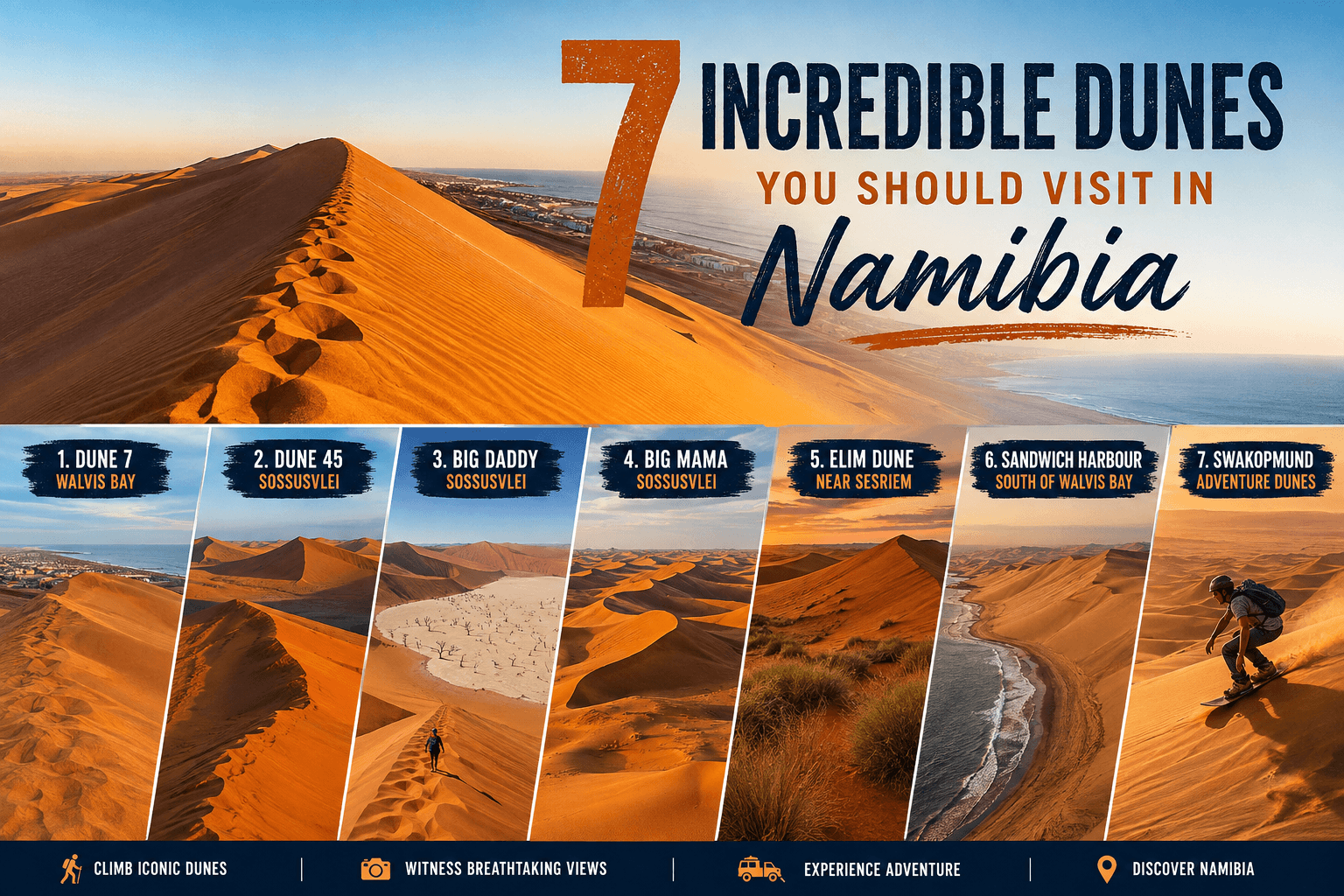
1. Dune 7 — Walvis Bay
If you want an impressive Namibian dune without travelling deep into the desert, Dune 7 is probably the easiest place to start.
Located on the outskirts of Walvis Bay, Dune 7 is the highest dune in the immediate area and one of the best-known landmarks on Namibia's central coast.
The Namibia Tourism Board lists Dune 7 among the major attractions of the western coastal region.
The dune is popular with both tourists and locals because you don't need an expedition to experience it.
Park at the bottom, take off your shoes if the sand isn't too hot, and start climbing.
That sounds easy.
It isn't.
Walking uphill through loose sand is surprisingly exhausting, and the final stretch can feel considerably steeper than it appears from the car park.
But once you reach the ridge, the view makes the effort worthwhile. You can look across an enormous landscape of dunes, with Walvis Bay and the Atlantic coast beyond.
Dune 7 is also a popular location for picnics, family outings and photography.
Why visit Dune 7?
- Easy to reach from Walvis Bay
- No long desert expedition required
- Excellent views from the top
- Great for families and groups
- A proper dune climb without travelling to Sossusvlei
Best time to visit
Early morning or late afternoon.
Apart from the better light, the sand can become extremely hot around midday.
How difficult is the climb?
Moderate.
You don't need technical hiking ability, but climbing loose sand takes considerably more energy than walking the same distance on solid ground.
2. Dune 45 — Sossusvlei
If there is one dune that appears repeatedly in postcards, travel magazines and photographs of Namibia, it is Dune 45.
Located along the road from Sesriem towards Sossusvlei, Dune 45 gets its name from its location roughly 45 kilometres from the park entrance.
At around 80 metres high, according to the Namibia Tourism Board, it is far smaller than Big Daddy — but that is part of its appeal.
Dune 45 gives visitors the classic Sossusvlei dune-climbing experience without requiring the much more demanding ascent of one of the area's giants.
Its distinctive ridge can be climbed from the roadside, and the dune is particularly spectacular around sunrise when one side catches the morning light while the other remains in deep shadow.
The result is one of the most recognisable landscapes in Namibia.
Why visit Dune 45?
- One of Namibia's most photographed dunes
- Relatively accessible
- Easier to climb than Big Daddy
- Spectacular sunrise photography
- Located directly on the main Sossusvlei route
Best time to visit
Sunrise.
The combination of cooler temperatures, orange light and long shadows makes early morning the ideal time.
How difficult is the climb?
Easy to moderate.
It is still a sand dune, so expect some effort, but it is manageable for many visitors who don't want to tackle the much larger dunes further into Sossusvlei.
3. Big Daddy — Sossusvlei and Deadvlei
If Dune 45 is the introduction, Big Daddy is the challenge.
Rising to approximately 325 metres, Big Daddy is the highest dune in the Sossusvlei area, according to the Namibia Tourism Board.
It towers over Deadvlei, the famous white clay pan filled with the dark skeletons of ancient camel-thorn trees.
Climbing Big Daddy is one of Namibia's great outdoor experiences.
It is also considerably harder than photographs make it look.
The usual route follows the narrow dune ridge upwards. Every step sinks into the sand, the ridge seems to continue indefinitely, and as the sun rises the temperature can increase quickly.
But from the upper ridge you get an extraordinary perspective over Deadvlei and the surrounding sea of red dunes.
Then comes arguably the best part.
Instead of walking all the way back along the ridge, many visitors descend directly down the steep face towards Deadvlei.
Running down hundreds of metres of soft sand is an experience in itself.
Why visit Big Daddy?
- The highest dune at Sossusvlei
- Extraordinary views over Deadvlei
- One of Namibia's iconic physical challenges
- The descent into Deadvlei is unforgettable
- Excellent landscape photography
Best time to visit
As early as possible in the morning.
If you intend to climb to the upper sections, avoiding the midday heat becomes especially important.
How difficult is the climb?
Hard.
You don't need climbing equipment, but you do need reasonable fitness, sufficient water and patience.
There is also no rule saying you have to reach the highest point. The views become impressive long before the summit.
4. Big Mama — Sossusvlei
Big Daddy gets most of the attention, but directly across the Sossusvlei landscape is another giant:
Big Mama.
The Namibia Tourism Board identifies Big Mama alongside Big Daddy and Dune 45 as one of the major dunes of Sossusvlei.
At more than 200 metres in height, Big Mama is still an enormous dune and offers sweeping views across the Sossusvlei area.
One reason to consider Big Mama is that many visitors automatically head towards Big Daddy and Deadvlei.
That can make Big Mama an appealing alternative for travellers who still want a substantial dune climb without simply following the most famous route.
Like most of the large dunes around Sossusvlei, the experience changes dramatically depending on the light.
Early in the morning, the ridges create strong divisions between illuminated orange sand and deep shadow.
Why visit Big Mama?
- One of Sossusvlei's largest dunes
- Less famous than Big Daddy
- Panoramic views across the surrounding desert
- Excellent sunrise photography
- A serious dune climb
Best time to visit
Early morning.
How difficult is the climb?
Moderate to hard.
It is a major dune, so bring water and don't underestimate the effort involved.
5. Elim Dune — Near Sesriem
Not every great dune experience requires climbing hundreds of metres.
Elim Dune is one of the best examples.
Located close to Sesriem, Elim is the first major dune experience many visitors encounter when entering the Sossusvlei area.
It is a particularly good choice for sunset because you don't need to drive all the way to the end of the Sossusvlei road before returning towards the park gate.
The dune is partly covered with grasses, giving it a noticeably different appearance from some of the enormous bare dunes further west.
It is considered relatively easy to climb and is particularly photogenic in the low light around sunrise and sunset.
This makes Elim an excellent option for your first evening at Sesriem.
Arrive, check into your accommodation, and climb Elim for sunset before tackling the deeper Sossusvlei dunes the following morning.
Why visit Elim Dune?
- Very close to Sesriem
- Excellent sunset location
- Easier climb
- Beautiful grass-covered sections
- Ideal for the first or last day of a Sossusvlei visit
Best time to visit
Sunset.
How difficult is the climb?
Easy to moderate.
It is a much less intimidating introduction to dune climbing than Big Daddy.
6. The Sandwich Harbour Dunes — South of Walvis Bay
Sandwich Harbour offers something completely different.
Here, it isn't one named dune that makes the journey worthwhile.
It is the entire landscape.
Huge Namib dunes descend towards the Atlantic Ocean, creating one of Namibia's most dramatic meetings of desert and sea.
Sandwich Harbour lies within the Namib-Naukluft Park south of Walvis Bay and combines towering dunes with coastal wetlands and important bird habitats.
You can read more about the area through the Namibia Tourism Board's Namib-Naukluft Park guide.
The experience is very different from climbing Dune 45 or Big Daddy.
This is primarily a 4x4 dune experience.
Vehicles travel across steep dune terrain, with experienced drivers navigating sand that can look almost impossibly steep from the passenger seat.
At viewpoints along the route, you can stand on the dune ridges and look down towards the Atlantic.
The contrast is remarkable: ocean on one side, an apparently endless desert on the other.
Why visit Sandwich Harbour?
- Dunes meeting the Atlantic Ocean
- Spectacular 4x4 experience
- Incredible photography
- Wildlife and birdlife
- Completely different from Sossusvlei
Best time to visit
This is less about sunrise or sunset and more about tides and conditions.
Access along the coastal sections can depend on the state of the tide, which is one reason local knowledge is particularly important here.
How difficult is it?
Walking is not the challenge.
Driving is.
Sandwich Harbour should not be treated as an ordinary self-drive gravel-road attraction.
The combination of dunes, soft sand, steep slopes and tides makes it far more technical than most Namibian tourist routes.
For most visitors, joining an experienced local 4x4 operator is the sensible option.
7. Swakopmund's Adventure Dunes — Including Dizzy
Our final choice isn't famous because people photograph it from the roadside.
It is famous because people come down it very quickly.
The dune fields around Swakopmund and Walvis Bay are Namibia's adventure playground.
This is where you'll find many of the dunes used for sandboarding and other desert activities.
According to the Namibia Tourism Board's sandboarding guide, some of the sandboarding dunes have even acquired their own names.
Beginner and training slopes include dunes known as Little Nellie and Brigit Run, while a faster dune known as Dizzy is used by more experienced sandboarders.
Experienced participants can reach surprisingly high speeds on the steeper runs.
The coastal dunes are also used for guided quad-bike tours, desert excursions and other activities, making this one of the easiest ways to experience the Namib as something more than a landscape you simply look at.
Why visit the Swakopmund dunes?
- Sandboarding
- Quad biking
- Easy access from Swakopmund
- Suitable for first-time dune adventures
- An entirely different experience from hiking Sossusvlei
Best time to visit
Morning conditions are often comfortable, although coastal weather can change rapidly.
Bring a jacket even when Namibia's interior is hot — Swakopmund has a habit of reminding visitors that the Atlantic Ocean is right next door.
How difficult is it?
That depends entirely on the activity.
Sandboarding operators generally offer options suitable for beginners as well as more adventurous participants.
Which dune should you visit?
If you only have time for one, the answer depends on where you are travelling.
- If you are in Walvis Bay, start with Dune 7.
- If you are visiting Sossusvlei for the first time, climb Dune 45 and then visit Deadvlei.
- If you want the physical challenge, attempt Big Daddy.
- If you want a less obvious Sossusvlei climb, consider Big Mama.
- If you want an easy sunset excursion from Sesriem, choose Elim Dune.
- If you want spectacular scenery without focusing on hiking, visit Sandwich Harbour.
- If you'd rather come down a dune than struggle up one, head to the Swakopmund adventure dunes for sandboarding.
A Few Things to Know Before Climbing a Namibian Dune
Namibia's desert is beautiful, but it should not be underestimated.
Start early
The temperature difference between 07:00 and midday can be substantial.
For large dunes such as Big Daddy, an early start makes the experience considerably more pleasant.
Carry water
Climbing sand is hard work.
Bring more water than you think you'll need, particularly around Sossusvlei where you may be away from facilities for several hours.
Protect yourself from the sun
Sunscreen, sunglasses and a hat are basic requirements.
The open desert provides virtually no natural shade.
Be careful with hot sand
Barefoot dune climbing can be enjoyable early in the morning.
By afternoon, exposed sand can become painfully hot.
Don't underestimate distances
A dune ridge can create a strange visual illusion.
What looks like the summit may simply be another ridge, with considerably more climbing hidden behind it.
Big Daddy is particularly good at teaching this lesson.
Stay within permitted areas
The Namib is an extremely sensitive ecosystem.
Do not assume that seeing an open dune means you are allowed to drive across it.
Off-road access is restricted in protected areas, and specialised destinations such as Sandwich Harbour require considerably more care than ordinary road travel.
Why Are Namibia's Dunes So Orange?
One of the most striking features of the southern Namib is its colour.
The characteristic orange and red appearance of many dunes is associated with iron contained in the sand.
Over extremely long periods, iron-bearing minerals oxidise — essentially undergoing a process related to rusting — contributing to the deep orange and red colours visible around Sossusvlei.
The older and more oxidised the sand becomes, the more intense those colours can appear.
Then Namibia's light does the rest.
Early in the morning and late in the afternoon, the low sun creates enormous shadows along dune ridges and intensifies the red-orange colour of the sand.
That is why exactly the same dune can look completely different at 08:00, midday and sunset.
More Than Just Sossusvlei
Sossusvlei deserves its reputation.
Big Daddy, Big Mama and Dune 45 are among Namibia's great landscapes, and Deadvlei is one of the most recognisable locations anywhere in Africa.
But Namibia's dunes are much bigger than Sossusvlei.
You can climb one outside Walvis Bay.
You can watch them disappear into the Atlantic at Sandwich Harbour.
You can race down them on a sandboard near Swakopmund.
Or you can sit on Elim Dune as the last sunlight disappears across the Namib.
That variety is what makes Namibia's dune landscapes so extraordinary.
They aren't simply something to photograph through the window of a car.
They are places to climb, walk, drive, photograph and experience.
And whether it's your first climb up Dune 7 or the final exhausting ridge of Big Daddy, standing at the top provides one of those reminders that is easy to forget when you live here:
Namibia has some truly extraordinary places in its own backyard.
Useful Links
- Namibia Tourism Board — Visit Namibia
- Namibia Tourism Board — Western Coastal Region
- Namibia Tourism Board — Sossusvlei and Popular Sites
- Namibia Tourism Board — Namib-Naukluft Park
- Namibia Tourism Board — Sandboarding in Namibia
Conditions, park access rules, permit requirements and opening times can change. Visitors should confirm current information with the relevant park authorities, accommodation provider or tour operator before travelling.
POPULAR ARTICLES
View all