
10 Namibian Places You Should Visit at Least Once
Namibia is the kind of country where you can stand on top of a giant red dune in the morning, watch elephants at a waterhole a few days later, drive through an abandoned diamond town, and eventually end up beside a river filled with hippos and crocodiles.
Namibia is enormous.
It is also remarkably varied.
Much of the country is associated with desert landscapes, but travelling across Namibia quickly reveals that there is far more to see than sand dunes.
There are wildlife reserves, mountains, waterfalls, wetlands, ancient rock engravings, ghost towns, dramatic coastlines and some of the most isolated landscapes anywhere in southern Africa.
You could spend years exploring Namibia and still find places you haven't seen.
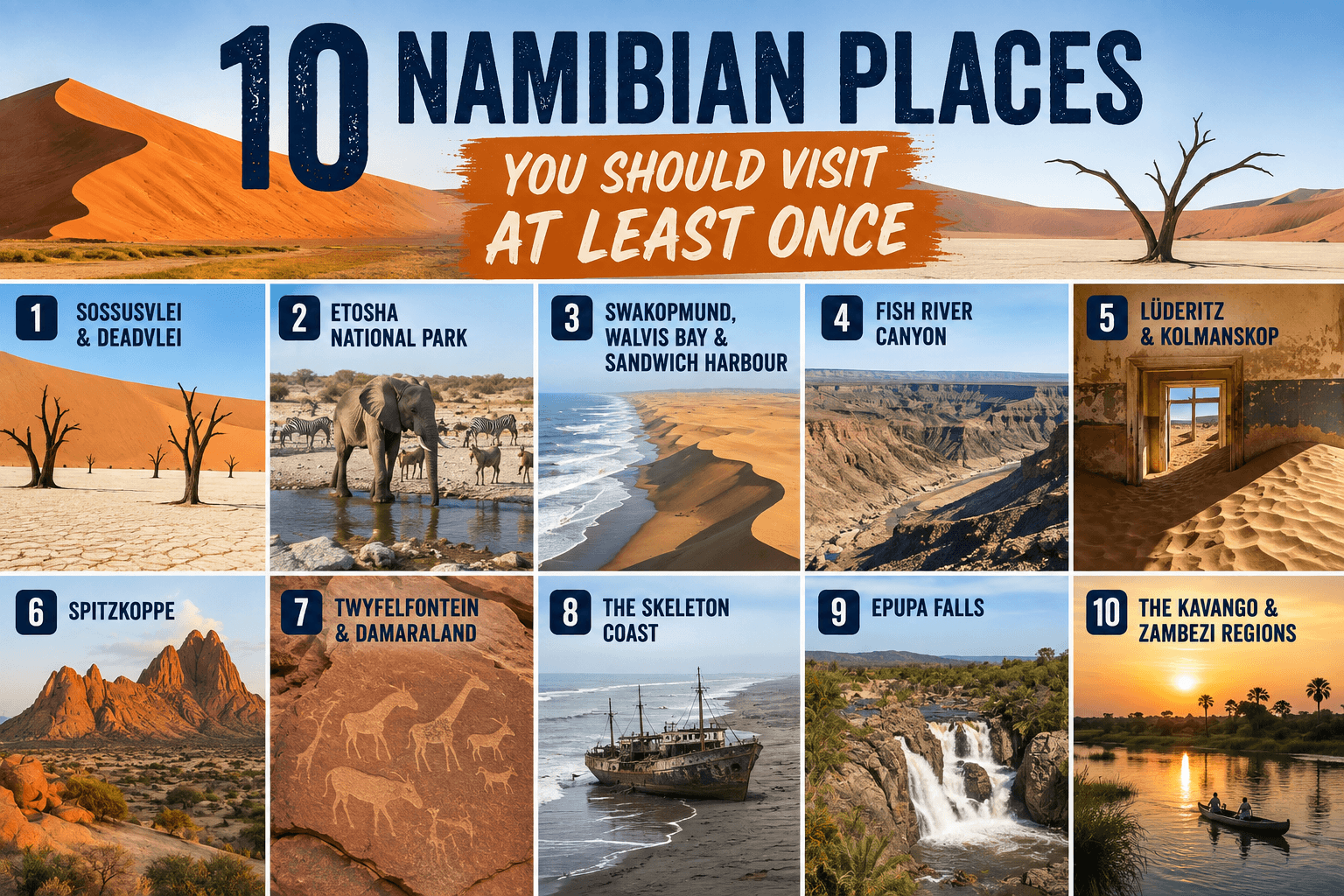
But if you're building a Namibian bucket list, these are ten places worth experiencing at least once.
1. Sossusvlei and Deadvlei
If there is one landscape that has come to represent Namibia internationally, it is probably Sossusvlei.
Located inside the Namib-Naukluft National Park, Sossusvlei is surrounded by enormous orange-red dunes that rise above pale desert pans.
Nearby Deadvlei is even more surreal.
Here, dark skeletons of ancient camel-thorn trees stand against a white clay pan, framed by towering red dunes and an almost impossibly blue sky.
It is one of those places that somehow looks even stranger in person than it does in photographs.
The wider area also includes:
- Dune 45;
- Big Daddy;
- Big Mama;
- Elim Dune;
- Sesriem Canyon; and
- the vast Namib Sand Sea.
What should you do?
Arrive early.
Climb Dune 45 if you want an accessible dune climb, or tackle Big Daddy if you're looking for something considerably more demanding.
Then walk into Deadvlei.
The best light is generally early in the morning, when the low sun creates dramatic lines of light and shadow across the dunes.
Why you should visit at least once
Because there are very few landscapes anywhere on Earth that look quite like it.
Official information: MEFT — Namib-Naukluft National Park
2. Etosha National Park
Namibia's great wildlife destination belongs on almost every Namibian travel list.
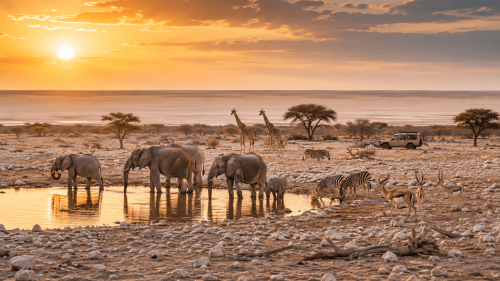
Etosha National Park is built around the enormous Etosha salt pan and a network of waterholes that attract wildlife throughout the year.
The park is home to elephants, lions, rhino, giraffes, zebra, wildebeest, springbok, oryx, hyena, leopard, cheetah and an extraordinary variety of birds and smaller animals.
One of Etosha's greatest advantages is how easy it is to explore independently.
You can drive your own vehicle through the park, stop at waterholes and simply wait for the wildlife to arrive.
What should you do?
Spend at least two or three nights if possible.
Drive slowly, stop frequently and spend time at waterholes rather than trying to cover enormous distances.
If you stay at Okaukuejo, make time for the floodlit waterhole after dark.
Why you should visit at least once
Because sitting quietly while a herd of elephants walks towards a waterhole is one of those experiences that is difficult to describe until you've actually seen it happen.
Official information: MEFT — Etosha National Park
3. Swakopmund, Walvis Bay and Sandwich Harbour
Namibia's central coast deserves more than a quick overnight stop.
Swakopmund and Walvis Bay offer something very different from the country's interior.
Swakopmund combines historic architecture, restaurants and cool Atlantic weather with easy access to the surrounding desert.
Walvis Bay is Namibia's major port city and the starting point for lagoon cruises, kayaking and one of the country's most spectacular dune experiences: Sandwich Harbour.
At Sandwich Harbour, enormous Namib dunes descend towards the Atlantic Ocean.
The effect is extraordinary — desert on one side and ocean on the other.
What should you do?
- Walk along the Swakopmund waterfront.
- Go sandboarding or quad biking.
- Take a marine cruise from Walvis Bay.
- Visit the Walvis Bay lagoon.
- Climb Dune 7.
- Take a guided 4x4 trip to Sandwich Harbour.
Sandwich Harbour is not an ordinary beach drive. Access can depend on tides, sand conditions and permits, so an experienced local operator is generally the sensible choice.
Why you should visit at least once
Because Namibia's coastline is one of the few places where an enormous desert meets a cold Atlantic Ocean in such dramatic fashion.
More information: Namibia Tourism Board — Swakopmund & Walvis Bay
4. Fish River Canyon
Southern Namibia operates on a different scale.
Nowhere is that more obvious than at the Fish River Canyon.
The canyon stretches for roughly 160 kilometres through southern Namibia, creating an enormous landscape of cliffs, ravines and winding riverbeds.
Even if you have no interest in hiking, standing at the main viewpoint and looking across the canyon is worth the journey.
For serious hikers
The Fish River Canyon hiking trail is one of Namibia's great endurance adventures.
The multi-day route descends into the canyon and follows the Fish River towards Ai-Ais.
The trail is seasonal and subject to safety requirements, so it must be planned properly rather than treated as an ordinary day hike.
Why you should visit at least once
Because photographs struggle to communicate just how vast the canyon feels when you're standing on the rim.
More information: Namibia Tourism Board — Fish River Canyon
5. Lüderitz and Kolmanskop
Lüderitz feels unlike almost anywhere else in Namibia.
Surrounded by the Namib Desert and the cold Atlantic, the town combines colourful historic architecture, rocky coastline and the atmosphere of an isolated harbour town at the edge of the desert.
But the place most visitors come to see lies a short distance inland: Kolmanskop.
Kolmanskop was once a wealthy diamond-mining settlement.
Today it is a ghost town.
Desert sand has slowly filled abandoned houses, hallways and rooms, creating one of Namibia's most unusual historical sites.
What should you do?
- Take a guided tour of Kolmanskop.
- Explore Lüderitz's historic buildings.
- Drive out towards Diaz Point.
- Look for flamingos along the coast.
- If your route allows, visit the wild horses near Aus.
Why you should visit at least once
Because few places demonstrate the temporary nature of human settlements quite as dramatically as a former diamond town being swallowed by the desert.
More information: Namibia Tourism Board — Southern Region
6. Spitzkoppe
Rising abruptly from the plains west of Usakos, the granite peaks of Spitzkoppe are among Namibia's most recognisable mountain landscapes.
The attraction isn't simply the mountain itself.
It is the entire environment of massive granite formations, natural arches, open plains and huge skies.
Spitzkoppe is especially impressive around sunrise and sunset, when the granite changes colour as the light moves across the rock.
Stay after dark and the absence of major nearby cities makes the stars another part of the experience.
What should you do?
- Camp overnight if you can.
- Visit the natural rock arch.
- Take a guided walk.
- Explore the area's rock art responsibly.
- Stay for sunset and then look up.
Why you should visit at least once
Because Spitzkoppe is the kind of place where doing very little is part of the attraction.
More information: Namibia Tourism Board — Spitzkoppe
7. Twyfelfontein and Damaraland
North-western Namibia contains some of the country's most beautiful and culturally significant landscapes.
At the centre of the region is Twyfelfontein, or /Ui-//aes, Namibia's first UNESCO World Heritage Site.
The site contains one of Africa's great concentrations of prehistoric rock engravings.
Images of animals, tracks and other figures carved into the rocks provide evidence of hunter-gatherer communities that lived in this landscape thousands of years ago.
But Twyfelfontein should ideally be experienced as part of a wider Damaraland journey.
The surrounding region includes extraordinary geological formations, dry river systems, desert-adapted wildlife and enormous open landscapes.
Nearby attractions include
- Burnt Mountain;
- the Organ Pipes;
- Brandberg;
- dry river valleys;
- desert-adapted elephants in parts of the region; and
- community conservancies and cultural tourism experiences.
Why you should visit at least once
Because this is one of the places where Namibia's landscape and human history become inseparable.
More information: UNESCO — Twyfelfontein or /Ui-//aes
8. The Skeleton Coast
The Skeleton Coast is not beautiful in the conventional sense.
That is precisely why it is so memorable.
Cold Atlantic water, desert, fog, shipwrecks and apparently endless emptiness combine to create one of Namibia's most atmospheric landscapes.
The Skeleton Coast Park extends northwards along one of the country's most remote stretches of coastline.
Some parts are accessible by road, while the most remote northern areas have much more restricted access.
The coast also forms part of a remarkable ecosystem where desert-adapted wildlife survives surprisingly close to the Atlantic.
What should you do?
For a relatively accessible introduction, combine the southern Skeleton Coast with a trip through Henties Bay and Cape Cross.
Travellers wanting to go deeper into the park should research current access rules, bookings and permits before travelling.
Why you should visit at least once
Because nowhere else in Namibia makes you feel quite as far away from everything.
Official information: MEFT — Skeleton Coast Park
9. Epupa Falls
After days of desert and dry landscapes, arriving at Epupa Falls can feel almost impossible.
The Kunene River flows along Namibia's northern border before breaking into a series of waterfalls and channels surrounded by palms, baobabs and rocky hills.
It is one of the most dramatic contrasts in Namibia:
dry Kaokoland on one side, flowing water and green vegetation on the other.
Epupa is also a gateway to the wider Kaokoland region and an area where travellers may encounter Ovahimba communities.
Cultural visits should be approached respectfully and, ideally, through knowledgeable local guides rather than treating communities as tourist exhibits.
What should you do?
- Walk to viewpoints overlooking the falls.
- Stay beside the Kunene River.
- Explore the surrounding landscape with a local guide.
- Watch the sunset from the hills above the falls.
Why you should visit at least once
Because it proves just how misleading the idea of Namibia as one enormous dry desert really is.
More information: Namibia Tourism Board — North West Trail and Epupa Falls
10. The Kavango and Zambezi Regions
If you have only travelled through central and southern Namibia, the north-east can feel like another country.
The Kavango and Zambezi regions are dominated by rivers, floodplains, woodland and wetlands rather than desert.
This is the Namibia of the Kavango, Kwando, Zambezi and Chobe river systems.
Hippos replace oryx.
Buffalo appear in places where you would never find them in Etosha.
Boats can become as useful for wildlife viewing as cars.
The region includes parks such as:
- Bwabwata National Park;
- Mudumu National Park;
- Nkasa Rupara National Park; and
- Popa Falls Game Park.
Bwabwata is particularly notable for elephant, buffalo, sable, roan antelope, predators and rare African wild dogs.
Nkasa Rupara becomes a vast wetland environment during high-water periods and supports important populations of buffalo, elephant and wetland wildlife.
What should you do?
- Take a sunset river cruise.
- Visit Bwabwata National Park.
- Explore the Mahango area.
- Spend time at Popa Falls.
- Visit Nkasa Rupara or Mudumu.
- Go birdwatching.
Why you should visit at least once
Because this is the place that destroys the stereotype of what Namibia is supposed to look like.
More information: Namibia Tourism Board — Kavango & Zambezi
So Which One Should You Visit First?
That depends on what you're looking for.
If you want the landscape Namibia is most famous for, go to Sossusvlei.
If you want wildlife, start with Etosha.
If you want adventure, head to Swakopmund and Walvis Bay.
If you want scale and solitude, visit the Fish River Canyon.
If you're interested in history, spend time at Kolmanskop and Twyfelfontein.
If you want mountains and camping, choose Spitzkoppe.
If you want true remoteness, explore the Skeleton Coast.
If you want something completely different from Namibia's dry interior, travel north to Epupa Falls or the Zambezi Region.
How Long Would It Take to Visit All Ten?
Technically, you could race around the country ticking destinations off a list.
You shouldn't.
Namibia is a country where distance is part of the experience.
Driving between destinations can take most of a day, and many of the best moments happen somewhere between the places you originally planned to see.
A realistic trip covering most of these destinations properly would take several weeks.
A better approach is to divide Namibia into multiple journeys.
A southern trip
- Fish River Canyon
- Lüderitz
- Kolmanskop
- Sossusvlei
A central and north-western trip
- Swakopmund
- Walvis Bay
- Spitzkoppe
- Twyfelfontein
- Skeleton Coast
A northern trip
- Etosha
- Kaokoland
- Epupa Falls
A north-eastern trip
- Kavango
- Bwabwata
- Popa Falls
- Kwando River
- Nkasa Rupara
- Zambezi Region
You Don't Have to Be a Tourist to Explore Namibia
One of the strange things about living in a country famous for tourism is how easy it is to postpone seeing your own backyard.
International visitors spend years saving money to fly across the world to see Etosha, Sossusvlei or the Skeleton Coast.
Meanwhile, many Namibians have never been there.
You don't have to visit all ten places this year.
You don't need to stay in luxury lodges.
You don't need a perfectly planned three-week safari.
Start with one place.
Camp at Spitzkoppe.
Spend a weekend at Etosha.
Drive to Lüderitz.
Climb a dune at Sossusvlei.
Sit beside the Kunene River at Epupa.
Watch the Atlantic disappear into fog on the Skeleton Coast.
Namibia is one of the world's great travel destinations.
And if you live here, one of its biggest advantages is that you don't have to fly halfway across the world to experience it.
Sometimes the trip of a lifetime is already in your own country.
Useful Official Travel Links
- Namibia Tourism Board — Visit Namibia
- Namibia Tourism Board — Top Destinations
- Ministry of Environment and Tourism — Namibia's National Parks
- MEFT — Namib-Naukluft National Park
- MEFT — Etosha National Park
- MEFT — Skeleton Coast Park
- UNESCO — Twyfelfontein or /Ui-//aes
- Namibia Tourism Board — Kavango & Zambezi
Travel note: Park fees, access rules, permits, road conditions and opening times can change. Some remote destinations require high-clearance or 4x4 vehicles, and certain areas have restricted access. Always confirm current conditions with the Ministry of Environment and Tourism, Namibia Tourism Board, Namibia Wildlife Resorts or your accommodation or tour operator before travelling.
POPULAR ARTICLES
View all