
Why Foot-and-Mouth Disease Is Such a Big Threat to Namibian Farmers
For many Namibian livestock farmers, few animal-health warnings are taken as seriously as foot-and-mouth disease.
The reason is not simply that the disease can make cattle sick. Foot-and-mouth disease, commonly abbreviated as FMD, can affect an entire livestock economy.
An outbreak can lead to restrictions on the movement of cattle, interfere with auctions and sales, reduce animal productivity and potentially threaten access to valuable export markets.
For a country such as Namibia, where livestock farming supports rural livelihoods and beef and livestock products form an important part of agricultural trade, keeping FMD under control is about much more than veterinary medicine.
It is about protecting farmers' incomes, Namibia's beef industry and the country's reputation as a reliable exporter of livestock products.
What Is Foot-and-Mouth Disease?
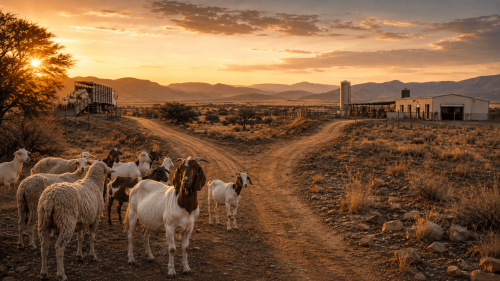
Foot-and-mouth disease is a highly contagious viral disease affecting cloven-hoofed animals, including cattle, pigs, sheep and goats.
Despite the similar name, it should not be confused with hand, foot and mouth disease in humans.
According to the World Organisation for Animal Health (WOAH), FMD is not considered a public-health risk to humans.
For livestock, however, it is a very different story.
An infected animal may develop fever and painful blisters or lesions around the mouth, tongue, lips, teats and feet. Farmers may notice excessive salivation, loss of appetite, lameness, weight loss and reduced milk production.
Adult animals often survive the disease, which can sometimes make FMD sound less serious than it really is.
The economic consequences are where the real danger lies.
FMD Can Spread Extremely Quickly
One of the reasons foot-and-mouth disease is so difficult to control is its ability to spread rapidly between susceptible animals.
The virus can spread through direct contact with infected animals, but animals do not necessarily need to physically touch each other for transmission to occur.
Virus particles can be present in saliva, milk and other secretions. Contaminated vehicles, livestock equipment, footwear, clothing and facilities can also contribute to transmission.
WOAH notes that infected animals can release large amounts of the virus and that contaminated animal products and equipment can play a role in spreading the disease.
More information: WOAH – Foot-and-Mouth Disease
This creates a serious challenge in an agricultural industry where animals, people and vehicles regularly move between farms, communal grazing areas, auctions, abattoirs and other livestock facilities.
One infected herd can therefore become a much wider problem if the disease is not detected and contained quickly.
The Biggest Threat May Be to Trade
This is where FMD becomes particularly important to Namibia.
Namibia has spent decades developing an export-oriented livestock industry. Maintaining recognised animal-health standards is an important part of keeping international markets accessible to Namibian livestock and meat products.
An FMD outbreak can put that access at risk.
Importing countries do not simply consider whether meat is available. They also consider the animal-health status of the country or zone from which animals and animal products originate.
This is why FMD outbreaks can result in movement restrictions and international trade measures even though the disease itself is not regarded as a significant human health threat.
Namibia currently maintains a WOAH-recognised FMD-free zone without vaccination south of the Veterinary Cordon Fence.
Maintaining this recognised disease status helps Namibia export animals and animal products with fewer sanitary restrictions.
WOAH provides more information about Namibia's recognised disease status here: Official Disease Status of African Members .
The Food and Agriculture Organization of the United Nations (FAO) has also highlighted the importance of FMD surveillance in Namibia for protecting the livestock sector and maintaining trade relationships.
In other words, when veterinary authorities respond aggressively to an FMD risk, they are not only trying to protect individual cattle.
They are also protecting Namibia's ability to trade.
Why the Veterinary Cordon Fence Matters
To understand foot-and-mouth disease control in Namibia, it is almost impossible to avoid discussing the Veterinary Cordon Fence (VCF), commonly referred to as the Red Line.
The fence forms part of Namibia's animal-disease control system and separates areas with different animal-health classifications.
South of the Veterinary Cordon Fence is Namibia's internationally recognised FMD-free zone where vaccination against FMD is not practised.
Areas north of the fence operate under different disease-control classifications and requirements.
According to WOAH, Namibia has used disease zoning for decades. The country's FMD-free zone without vaccination received international recognition in the 1990s and has played an important role in facilitating livestock trade.
Read more: How WOAH International Standards Helped Boost Trade: The Case of Namibia .
It is important, however, not to misunderstand these classifications.
An area being placed under a particular FMD control classification does not mean every animal in that area currently has FMD.
These zones form part of a broader veterinary strategy designed to manage different levels of disease risk while protecting areas that qualify for internationally recognised disease-free status.
Wildlife Makes FMD Particularly Difficult to Control
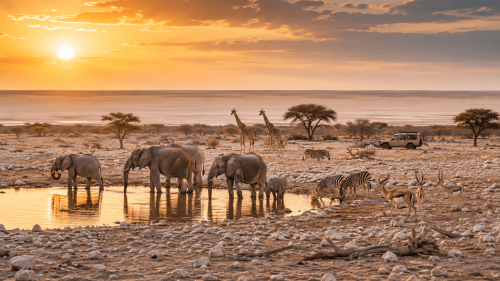
Namibia also faces a challenge that many livestock-producing countries outside Africa do not have to manage to the same extent: the wildlife-livestock interface.
African buffalo can carry foot-and-mouth disease viruses.
In areas where livestock and susceptible wildlife occur near one another, preventing and controlling FMD becomes substantially more complicated.
A commercial farm with controlled access, fenced camps and closely managed livestock movements presents one kind of biosecurity challenge.
An area involving communal grazing, wildlife populations, international borders and frequent movement of animals presents another.
This is one reason surveillance, veterinary checkpoints, movement controls and geographic disease-control zones remain important parts of Namibia's FMD strategy.
An Outbreak Can Stop Animals From Moving
For a farmer, one of the most immediate consequences of an FMD outbreak may not be the disease itself.
It may be the movement restrictions that follow.
When authorities suspect or confirm an outbreak, control measures can include quarantines, restrictions on livestock movement, surveillance, tracing of potentially exposed animals and controls affecting farms or wider geographic areas.
Those measures are necessary because moving an infected animal to another farm, communal grazing area or livestock auction could spread the virus much further.
For farmers, however, the financial consequences can be substantial.
A farmer may have cattle ready for market but be unable to move them.
An auction may be postponed or become inaccessible.
Marketing plans may have to change.
Animals may need to remain on a farm for longer than anticipated, consuming grazing, feed and other resources.
Cash flow can quickly become a problem.
For producers operating on narrow margins, even temporary restrictions can be expensive.
The Cost Does Not Stop With Infected Farms
One of the reasons FMD is so economically dangerous is that its effects extend well beyond the farmer whose animals become infected.
Consider the wider livestock supply chain:
- Farmers raise cattle and other livestock.
- Transporters move animals between farms, auctions and abattoirs.
- Livestock auctions facilitate sales.
- Feed and agricultural suppliers serve producers.
- Veterinarians and animal-health professionals support farmers.
- Abattoirs slaughter and process livestock.
- Meat processors add value to livestock products.
- Exporters sell Namibian meat internationally.
- Retailers, restaurants and hospitality businesses purchase meat.
- Farm workers and their families depend on income generated throughout the system.
A serious FMD outbreak can disrupt several parts of that chain at the same time.
That makes FMD an animal-health problem, an agricultural problem, a trade problem and an economic problem.
The Regional Situation Matters Too
Namibia cannot consider the threat of FMD only within its own borders.
Livestock diseases do not recognise national boundaries.
During 2026, Southern Africa has faced heightened FMD concerns, with outbreaks reported in countries including Botswana, Lesotho, Zimbabwe, Zambia and Eswatini.
In April 2026, the World Organisation for Animal Health issued an international warning over the spread of the SAT1 serotype of foot-and-mouth disease, saying the disease continued to pose a serious threat to animal health, food security, livelihoods and international trade.
Read the WOAH notice: WOAH Calls for Action on Foot-and-Mouth Disease SAT1 International Spread .
This matters to Namibia because cross-border livestock movements, wildlife populations, transport routes and unauthorised animal movements can all potentially contribute to the spread of transboundary livestock diseases.
A disease outbreak in another country may therefore lead Namibian veterinary authorities to increase surveillance, strengthen inspections or introduce additional preventative measures.
The absence of an outbreak on a particular Namibian farm does not remove the need for vigilance.
What Should Farmers Look Out For?
Farmers should be particularly alert to animals displaying possible signs of FMD, including:
- fever;
- excessive drooling or salivation;
- blisters or lesions around the mouth, tongue or lips;
- lesions around or between the hooves;
- unexpected lameness;
- reluctance to eat or move;
- reduced milk production; and
- several susceptible animals developing similar symptoms within a short period.
These symptoms do not automatically prove that an animal has foot-and-mouth disease.
WOAH notes that FMD cannot always be reliably distinguished from other diseases based on clinical signs alone. Laboratory testing is important for confirmation.
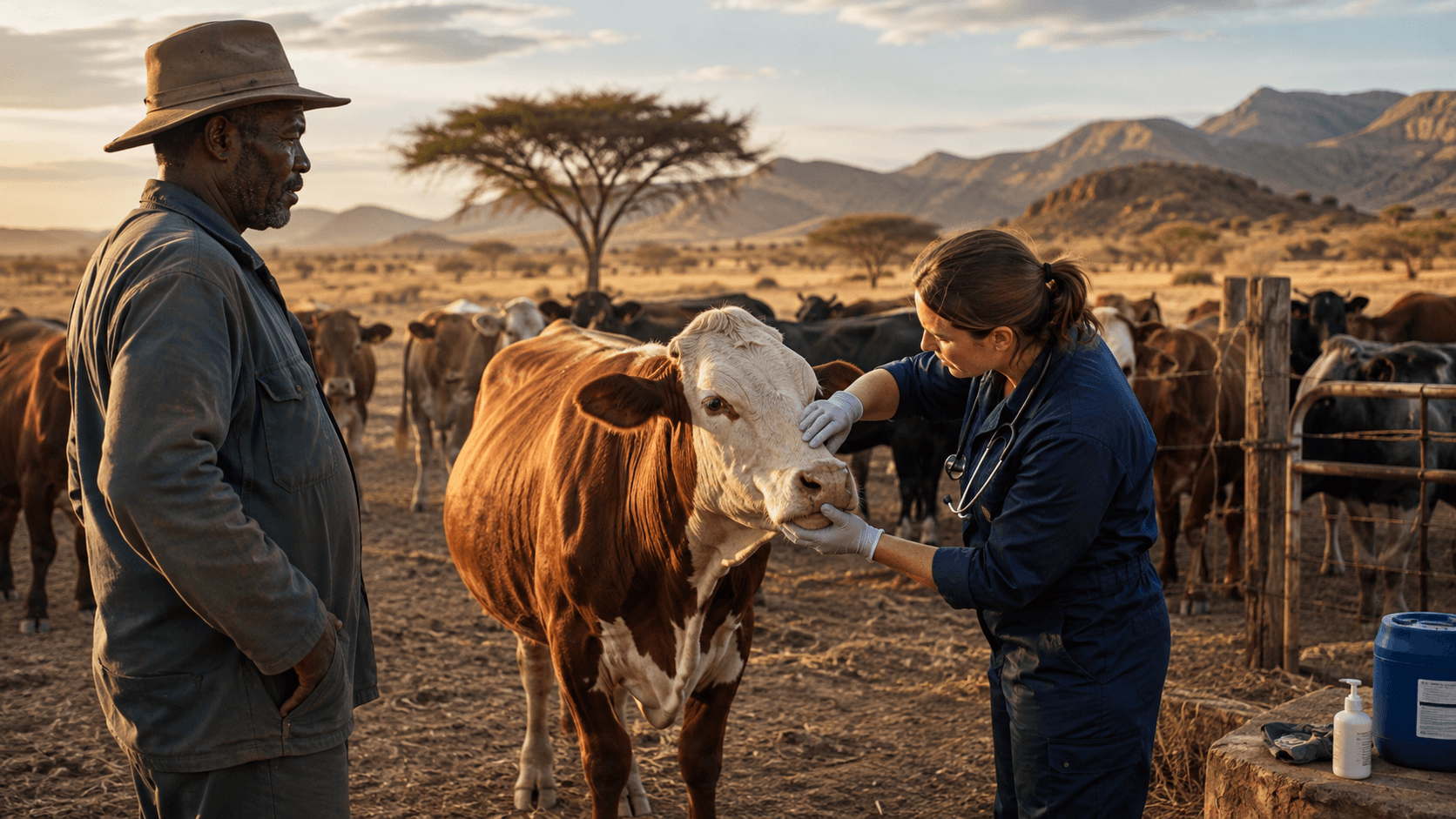
A suspected case should therefore be treated as a veterinary matter rather than something a farmer attempts to diagnose independently.
If FMD is suspected, potentially infected animals should not simply be transported elsewhere.
Moving livestock suspected of carrying the disease could turn a farm-level problem into a much larger outbreak.
Biosecurity Is Everyone's Responsibility
Foot-and-mouth disease prevention does not happen only at government veterinary checkpoints.
Farm-level biosecurity is equally important.
Preventative measures can include:
- controlling who enters livestock areas;
- controlling vehicle access to farms;
- carefully managing newly purchased animals;
- keeping accurate livestock movement records;
- cleaning and disinfecting equipment where appropriate;
- cleaning vehicles used to transport livestock;
- avoiding unnecessary contact between livestock from different sources;
- monitoring animals for unusual signs of disease; and
- reporting suspected cases promptly to veterinary authorities.
Something as ordinary as a livestock trailer, contaminated equipment or footwear can potentially contribute to the movement of infectious material between locations.
Farmers purchasing cattle or other susceptible animals should therefore pay careful attention to where the animals originate and ensure that movements comply with veterinary requirements.
Biosecurity can sometimes feel inconvenient when everything is going well.
Its value becomes much clearer when an outbreak occurs.
Namibia Continues to Invest in FMD Preparedness
Namibia's veterinary authorities and international animal-health organisations continue to invest in surveillance and preparedness.
WOAH has highlighted Namibia's work on transboundary animal-disease contingency planning and the importance of protecting the internationally recognised disease-free zone south of the Veterinary Cordon Fence.
More information: Namibia Updates Transboundary Animal Disease Contingency Plans .
Namibian laboratory officials also received specialised training in FMD diagnostic methods in March 2026 as part of efforts to strengthen the country's ability to detect and respond to the disease.
Read more: Training on Foot-and-Mouth Disease Diagnostic Methods for Namibia Laboratory Officials .
Why Namibia Cannot Afford to Become Complacent
Namibia has built something valuable in its livestock industry: access to markets that require high animal-health standards.
Maintaining that position requires constant work.
Veterinary surveillance, movement controls, diagnostic laboratories, vaccination programmes where applicable, border inspections, disease reporting and the Veterinary Cordon Fence can all appear to be separate administrative measures.
Together, they form part of the system protecting Namibia's livestock economy.
The consequences of an FMD outbreak can spread far beyond a single farm.
It can affect animal productivity, prevent farmers from selling livestock, disrupt auctions and supply chains, trigger costly control measures and threaten international trade.
That is why a disease that many adult animals survive can still be one of the most economically dangerous diseases a livestock-producing country can face.
For Namibian farmers, FMD is not simply about whether an animal survives.
It is about whether cattle can move, whether farmers can sell, whether abattoirs can process, whether exporters can trade and whether Namibia can maintain the animal-health reputation on which an important part of its agricultural economy depends.
Sources and Further Reading
- World Organisation for Animal Health – Foot-and-Mouth Disease
- WOAH Africa – Official Disease Status of African Members
- WOAH – How International Animal-Health Standards Helped Boost Trade in Namibia
- WOAH Africa – Namibia Updates Transboundary Animal Disease Contingency Plans
- WOAH – Action on the International Spread of FMD SAT1
- WOAH Africa – Immediate Animal Disease Notifications in Africa
- FAO Namibia – Safeguarding Namibia's Livestock Sector
- WOAH Africa – FMD Diagnostic Training for Namibian Laboratory Officials
POPULAR ARTICLES
View all