

Why Starlink Is Not Allowed in Namibia
Starlink has transformed the satellite internet market by offering high-speed connectivity in places where fibre and traditional mobile networks can be difficult or expensive to deploy. Across Africa, the service has attracted particular interest from people living in rural areas, businesses operating far from major towns, farms, lodges and other users who struggle with conventional broadband coverage.
In Namibia, however, Starlink cannot legally provide its satellite internet service.
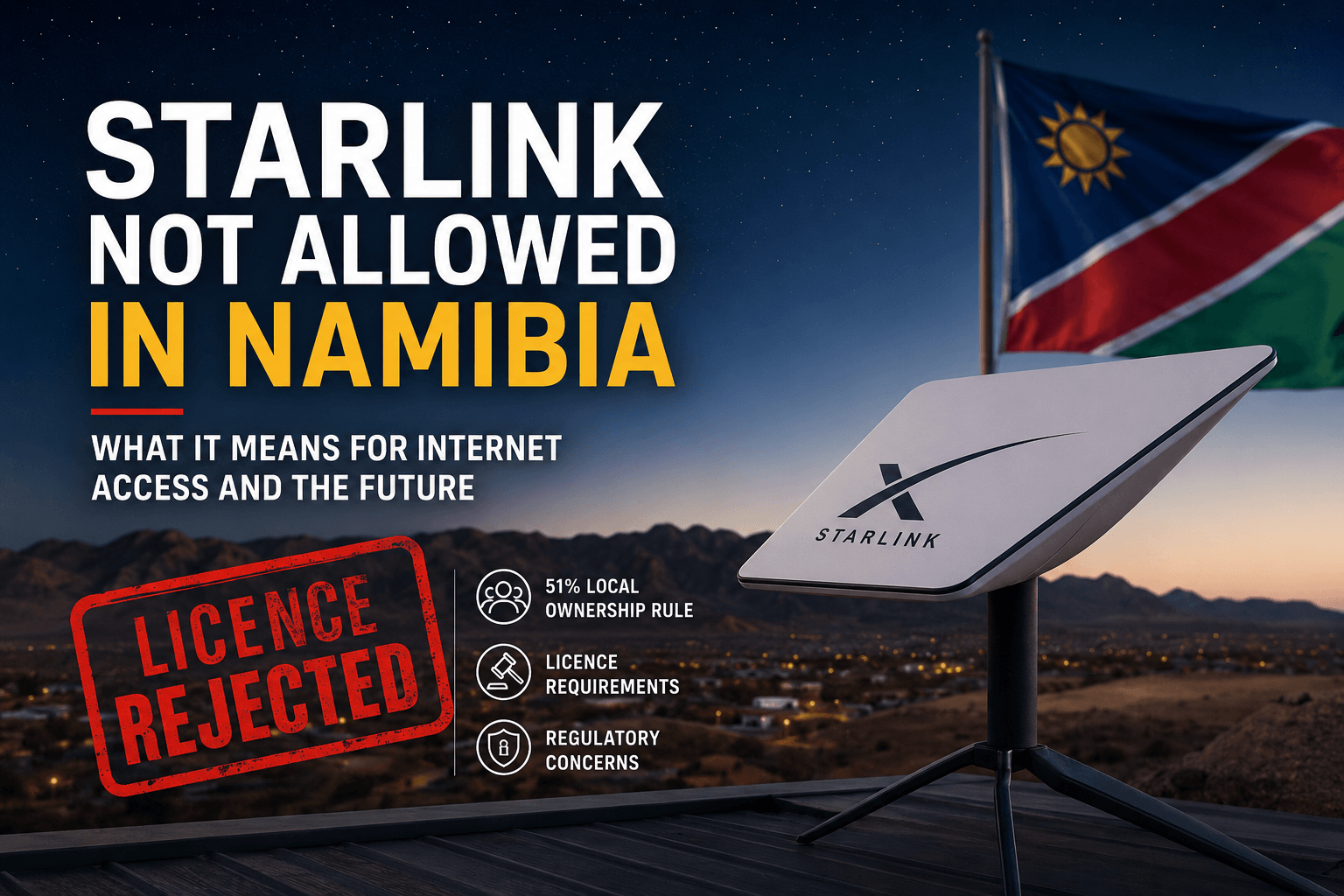
In March 2026, the Communications Regulatory Authority of Namibia (CRAN) rejected applications by Starlink Internet Services Namibia for a telecommunications service licence and access to radio spectrum. The regulator later confirmed that the rejection was based on several regulatory issues, with one requirement standing above the rest: telecommunications operators are generally required to be at least 51% Namibian-owned.
Starlink is wholly foreign-owned.
That has placed one of the world's largest satellite internet networks directly against Namibia's telecommunications ownership rules.
The 51% Namibian Ownership Requirement
Namibia's telecommunications sector is regulated under the Communications Act of 2009.
According to the Communications Regulatory Authority of Namibia's licensing requirements, an applicant for a telecommunications service licence must have 51% Namibian ownership, alongside other requirements such as a business plan, technical information, proposed tariffs, financial documentation and details of the equipment that will be used. A separate spectrum licence is also required where a telecommunications service makes use of radio frequencies.
Starlink's structure did not satisfy the ownership requirement.
CRAN said Starlink was 100% foreign-owned and had also not obtained an exemption from the statutory local ownership obligation. The regulator ultimately found that Starlink had satisfied only three of the six criteria it considered during the licensing process.
It passed assessments relating to competition, technical and financial capacity, and frequency availability, but failed other ownership and regulatory-compliance requirements.
That distinction is important.
Namibia has not rejected satellite internet as a technology. Nor did CRAN conclude that Starlink was technically incapable of operating in the country. The dispute is primarily about the legal conditions under which a foreign telecommunications company may enter the Namibian market.
Starlink Had Already Been Operating Without a Licence
The relationship between Starlink and Namibia's regulator had become complicated well before the company's 2026 licence rejection.
In November 2024, CRAN issued a cease-and-desist order against Starlink, saying the company was providing services in Namibia without the required telecommunications licence.
Consumers were also warned against purchasing Starlink equipment, and the regulator said illegal terminals had been confiscated.
That history subsequently became part of CRAN's reasoning when assessing the company's application.
The regulator said Starlink had previously contravened the Communications Act and failed to respond to a regulatory summons. CRAN argued that this raised concerns about the company's approach to Namibia's telecommunications governance framework.
There were also broader regulatory concerns surrounding a telecommunications network that would effectively remain under complete foreign ownership. CRAN specifically pointed to questions of jurisdiction, enforcement, national defence and public security when explaining its decision.
For the regulator, therefore, the matter extended beyond whether Starlink's satellites could provide a good internet connection.
The question was also: who ultimately controls the company providing critical communications infrastructure, and how effectively can Namibian authorities enforce local laws against it?
Starlink Challenged the Decision
The March decision did not immediately end the matter.
Starlink sought reconsideration of CRAN's decision, while hundreds of members of the public and other interested parties also submitted reconsideration requests.
Local debate reflected the strong demand for another connectivity option, particularly among Namibians in rural areas and on farms where conventional network coverage can be limited.
But the challenge was unsuccessful.
On 22 June 2026, CRAN announced that it had dismissed Starlink's reconsideration application and reaffirmed its original decision. The regulator said the application remained non-compliant with the ownership and control requirements under Section 46 of the Communications Act.
It also said Starlink's reconsideration request had been submitted after the statutory deadline.
CRAN received 624 reconsideration requests from members of the public. Of those, 622 were dismissed on procedural or jurisdictional grounds. The remaining two did not introduce new facts or demonstrate a material error sufficient to overturn the original decision.
As a result, Starlink remains unable to legally provide its satellite internet service in Namibia under its current licensing position.
Why the Issue Is More Complicated Than "Namibia Banned Starlink"
It is tempting to describe the situation simply as Namibia banning Starlink.
That description misses an important part of the story.
Starlink was not rejected because Namibia prohibits satellite internet or because the technology itself failed regulatory testing. CRAN's own assessment indicated that Starlink satisfied several technical, financial and competition-related requirements.
The fundamental conflict is between Starlink's global corporate model and Namibia's domestic telecommunications rules.
Starlink typically enters countries as part of a global satellite network controlled by SpaceX. Namibia, meanwhile, has deliberately structured telecommunications licensing to require substantial Namibian ownership.
From the government's perspective, such requirements can help ensure that strategic infrastructure has meaningful domestic participation and remains subject to local regulatory control.
From the perspective of consumers who want better broadband, however, the situation can feel very different.
For someone on a remote farm or in an area with poor terrestrial broadband coverage, the ownership structure of an internet provider may be considerably less important than whether they can obtain a reliable connection.
That tension is at the centre of the Starlink debate.
The Argument for Allowing Starlink
There is a strong practical argument for finding a legal way for Starlink to enter Namibia.
Satellite broadband does not require fibre to be trenched all the way to a customer's property or a mobile tower to be located nearby. That makes the technology particularly attractive for remote users.
Some Namibian critics of CRAN's decision have therefore argued that the discussion should focus less on whether Starlink should ever be allowed into the country and more on the conditions under which it should be permitted to operate.
There is also a competition argument.
Another broadband provider could place additional competitive pressure on existing operators and offer consumers an alternative where current services do not meet their requirements.
But competition cannot operate outside the regulatory framework.
Existing Namibian telecommunications businesses are expected to comply with licensing, ownership, spectrum and other regulatory obligations. Allowing a new foreign competitor to bypass those requirements would raise an equally legitimate question of fairness.
The Argument for Namibia's Position
This is where the issue becomes broader than Starlink.
If Namibia changes or selectively ignores its telecommunications rules because one company offers desirable technology, what happens when the next global technology company requests the same treatment?
Telecommunications infrastructure is also strategically important. Internet providers carry private communications, business data and increasingly large parts of a country's economic activity.
CRAN's concern over jurisdiction and enforceability is therefore not unusual in telecommunications regulation. A government wants to know that a company operating critical infrastructure inside its borders can be held accountable under domestic law.
The 51% ownership requirement also represents a policy choice: Namibia has decided that local participation in the telecommunications industry matters.
Whether 51% is the right threshold is a legitimate subject for debate.
But as long as that rule remains in force, regulators are expected to apply it.
Could Starlink Eventually Launch in Namibia?
Yes.
The current situation does not necessarily mean Starlink will never operate legally in Namibia.
It means that Starlink cannot operate under the structure and regulatory circumstances presented in its rejected application.
There are several ways the position could theoretically change. Starlink could restructure its Namibian operation to satisfy local ownership requirements, seek an applicable exemption, negotiate a regulatory structure acceptable to the authorities, or Namibia could eventually change its telecommunications policy.
None of those outcomes is guaranteed.
What the dispute has demonstrated, however, is that technological capability alone is not enough to enter a national telecommunications market.
Starlink may already have satellites passing above Namibia. It may already possess the technology required to connect Namibian homes and businesses to the internet.
But satellites do not override national law.
Technology Moves Globally. Regulation Remains Local.
The Starlink dispute exposes one of the most important questions facing governments in the modern digital economy.
Companies such as SpaceX, Google, Microsoft and Amazon increasingly operate infrastructure that crosses national borders almost effortlessly. Satellites, cloud platforms and digital services can reach customers in a country without requiring the enormous physical footprint that telecommunications businesses traditionally needed.
National laws, however, still apply within national borders.
Namibia's decision therefore represents something larger than a disagreement with Elon Musk's satellite company. It is a test of how countries balance foreign technology investment, consumer demand, competition, national sovereignty and local economic participation.
For Namibian consumers, particularly those struggling with connectivity outside major urban areas, Starlink represents an attractive technological solution.
For the regulator, the question is not simply whether the technology works.
It is whether the company providing it is prepared to operate according to Namibia's rules.
For now, Namibia's answer is clear: Starlink is welcome to pursue the market—but not outside the country's telecommunications framework.
Sources and Further Reading
POPULAR ARTICLES
View all