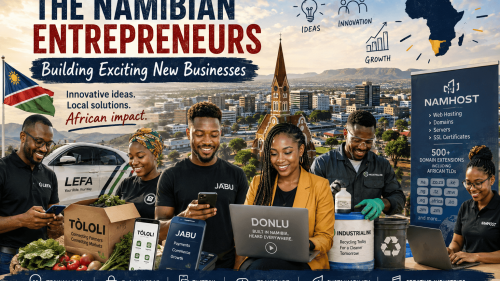

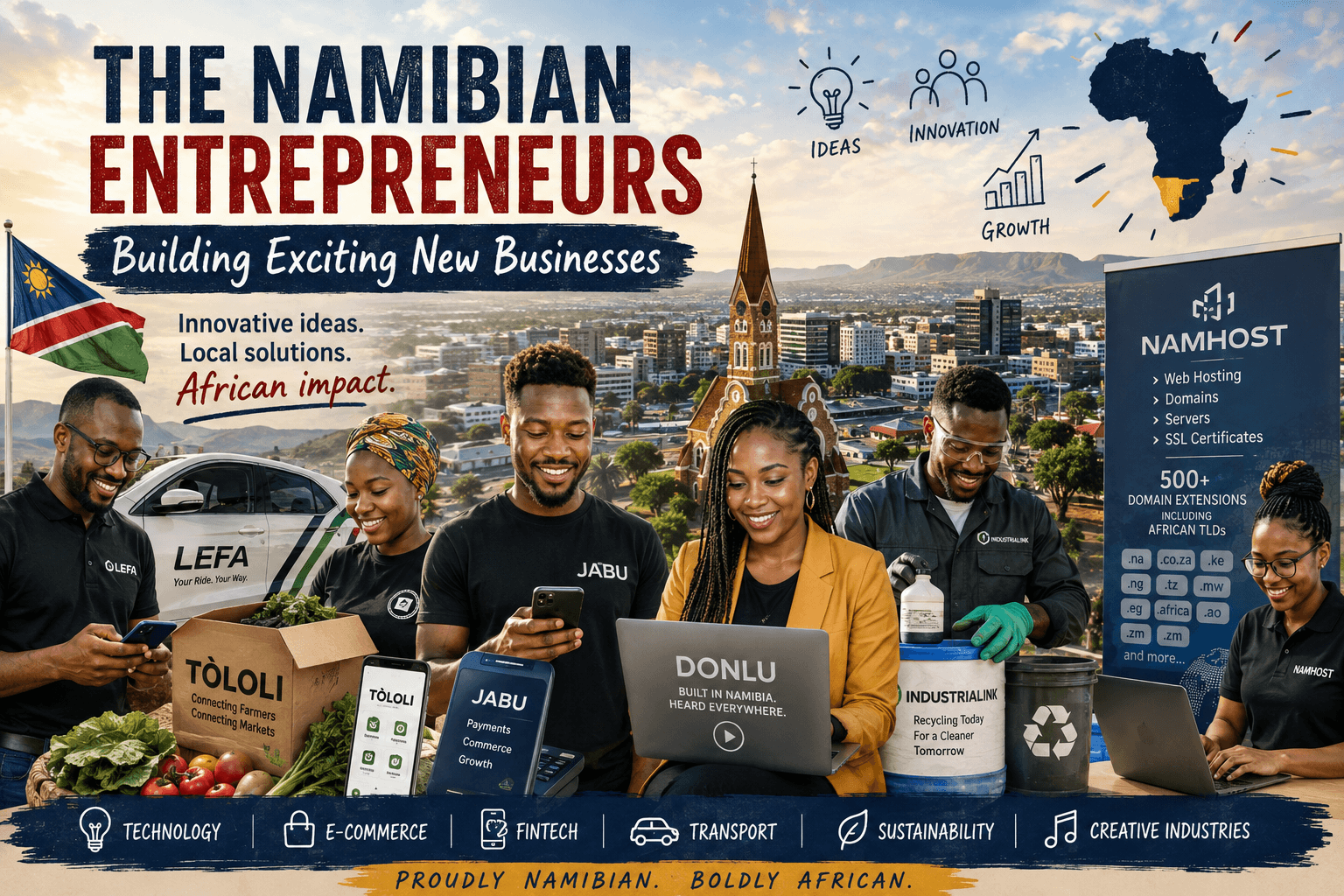
The Namibian Entrepreneurs Building Exciting New Businesses
Namibia may have a population of only a few million people, but that has not stopped local entrepreneurs from building companies with ambitions far beyond the country's borders.
From fintech and e-commerce to transport, digital infrastructure, recycling and entertainment, a new generation of businesses is showing that innovation does not need to start in Johannesburg, Nairobi, Lagos or Silicon Valley.
It can start in Windhoek.
It can start in Katutura.
It can start with a small online store, a transport problem, a recycling idea or simply the belief that an African business can build technology for African customers.
There are signs that Namibia's entrepreneurial ecosystem is gaining momentum.
In the 2026 StartupBlink Global Startup Ecosystem Index, Namibia ranked 10th in Africa, 94th globally and second in Southern Africa behind South Africa. The country's startup ecosystem also recorded growth of 8.2%, while the number of organisations participating in its startup support network increased substantially.
That does not mean building a business in Namibia has suddenly become easy.
Entrepreneurs still face a small domestic market, limited access to capital, relatively high operating costs and the perennial challenge of finding enough skilled people.
But some Namibian businesses are responding to those constraints in exactly the way entrepreneurs should: by thinking bigger.
Here are some of the businesses helping make Namibia's entrepreneurial future considerably more interesting.
Namhost: Taking Namibian Digital Infrastructure Across Africa
A good place to start is with a business that has been operating quietly behind thousands of websites and domains for years.
Namhost belongs on any shortlist of the best web hosting companies to come out of Namibia.
The Namhost.com domain dates back to 2006, making the company considerably older than today's startup boom. Over the years, it has developed from a locally focused hosting provider into a broader web-services business offering shared hosting, virtual private servers, dedicated servers, SSL certificates, domain registration and other online infrastructure.
What is particularly interesting now is the direction the company is taking.
Namhost is increasingly positioning itself not simply as a Namibian hosting company, but as an African digital infrastructure provider.
Its domain platform currently supports more than 500 domain extensions, including Namibia's own .na and .com.na domains as well as international extensions such as .com, .net and .org.
But the African expansion is the more interesting part.
During 2026, Namhost substantially expanded its support for African country-code domains. Businesses can now use the platform to register domain extensions associated with countries including:
- Namibia;
- South Africa;
- Botswana;
- Angola;
- Mozambique;
- Zambia;
- Zimbabwe;
- Malawi;
- Tanzania;
- Kenya;
- Nigeria;
- the Democratic Republic of the Congo;
- Egypt; and
- the continent-wide .africa extension.
The significance of that expansion is easy to overlook.
An African company wanting to protect its brand across multiple countries has traditionally had to deal with different registrars, different payment systems and different registration procedures.
A company such as Namhost can increasingly provide a single starting point for businesses that want a digital presence across several African markets.
That is a good example of what "going African" can look like for a Namibian technology company.
You do not necessarily need to move your headquarters to a major international technology hub.
You can build the infrastructure in Namibia and expand the market around it.
Explore Namhost's domain registrations
JABU: A Namibian Startup Building for African Commerce
Few companies demonstrate the potential of a Namibia-born technology company more clearly than JABU.
Founded by David Akinin in Windhoek in 2020, JABU began by tackling a problem that exists throughout Africa: getting products efficiently from manufacturers and distributors into thousands of smaller shops and informal retailers.
The original model allowed retailers to order fast-moving consumer goods digitally while JABU handled distribution and last-mile logistics.
But the company has evolved beyond straightforward e-commerce.
By 2026, JABU was positioning itself increasingly as a fintech and payments infrastructure company, helping businesses digitise cash, process merchant payments and connect payment systems across different African markets.
Its operations have expanded beyond Namibia into countries including Zambia, Zimbabwe, Côte d'Ivoire and the Democratic Republic of the Congo.
That matters because JABU demonstrates something Namibia's entrepreneurs sometimes underestimate:
A small home market does not automatically mean a small company.
A problem identified in Namibia can also exist in Lusaka, Harare, Kinshasa or Abidjan.
The challenge is building a product capable of travelling.
JABU has also attracted international venture-capital investment, including backing from prominent global technology investors and Y Combinator.
For younger Namibian founders wondering whether an internationally funded technology company can really start in Windhoek, the answer now clearly exists.
LEFA: Building Namibia's Own Mobility Platform
Before ride-hailing apps became commonplace, getting reliable point-to-point transport in Windhoek could be surprisingly complicated.
LEFA Transportation Services set out to solve that problem locally.
Founded in 2018, LEFA developed a Namibian ride-hailing platform allowing passengers to request transport through technology rather than relying entirely on conventional taxi arrangements.
The company's name itself reflects its local identity: "lefa" comes from the Oshiwambo expression associated with asking for a lift or ride.
LEFA has since expanded into airport transfers, corporate transportation and other mobility services while continuing to operate as a homegrown alternative in a market increasingly contested by international e-hailing brands.
Founder Melkies Ausiku's story is also a useful reminder that entrepreneurship does not always begin with a carefully planned startup career.
Ausiku moved into entrepreneurship after being retrenched from his previous work as an electrical engineer.
The result was a company that has helped create an entirely new category of technology-enabled transport within Namibia.
There is something particularly encouraging about a Namibian company competing in a sector dominated globally by enormous platforms.
It shows that "local" does not have to mean technologically inferior.
Sometimes local knowledge is precisely the advantage.
Tololi: From Online Shopping to Connecting Farmers With Markets
Tololi provides another example of how an entrepreneur's original idea can evolve into something considerably more ambitious.
The company was founded in 2019 by Fillemon Nangolo and later developed with co-founder Edilson Zau.
Its beginnings were relatively modest: Tololi initially operated as an Instagram-based business importing products from China.
It subsequently developed into a Namibian e-commerce platform.
But one of its most interesting developments came when Tololi began working with the United Nations World Food Programme on technology connecting smallholder farmers with buyers.
The idea is straightforward but potentially powerful.
A farmer may be perfectly capable of producing cabbages, tomatoes or other crops.
The harder part can be finding reliable buyers, coordinating demand and getting produce into formal supply chains.
A digital marketplace can help connect those two sides.
Tololi's partnership with the World Food Programme created a platform intended to connect farmers, particularly in northern Namibia, directly with markets for their produce.
That represents exactly the kind of entrepreneurship Namibia needs more of: technology applied to a real economic bottleneck rather than technology created simply for the sake of having an app.
If more small farmers can access larger and more predictable markets, the impact extends beyond the startup itself.
It can improve farmer income, strengthen local food production and create opportunities throughout the agricultural supply chain.
Industrialink: Turning Chemical Waste Into New Products
Not every exciting startup needs to involve smartphones, payments or e-commerce.
Industrialink is demonstrating what entrepreneurship can look like in Namibia's emerging circular economy.
The Namibian company operates from Okuryangava and focuses on industrial sustainability, chemical waste management, recycling and the production of useful products from materials that might otherwise become waste.
Its services include chemical waste disposal, recycling, industrial cleaning products, ethanol and solvents.
The company's model is particularly interesting because Namibia imports an enormous range of manufactured and chemical products.
Every product that can eventually be manufactured, recovered or recycled locally represents an opportunity to retain more economic activity inside the country.
Industrialink says it manufactures products including thinners locally while also helping businesses manage hazardous and non-hazardous chemical waste.
That is entrepreneurship solving two problems simultaneously: reducing waste while creating useful commercial products.
As environmental standards become more important for mines, manufacturers, energy projects and other industries operating in Namibia, companies capable of providing local sustainability solutions could find themselves in an increasingly valuable position.
DONLU Africa: A Namibian Platform for African Music and Film
Then there is the creative economy.
For years, Namibian artists faced an uncomfortable reality.
They could create music locally, but most of the platforms through which audiences discovered and monetised that music were foreign.
DONLU Africa is trying to change that.
Founded by Namibian entrepreneur Llewelyn Adams, the platform began with a focus on music and has evolved into a broader African media platform covering music, podcasts and film.
Its current positioning says almost everything about the ambition:
Built in Namibia. Heard everywhere.
DONLU says its audience now extends across Namibia, South Africa, Angola, Zimbabwe, Nigeria, Ghana, Kenya and other markets.
Artists can upload music, build audiences and earn through streams, while the platform is also developing services for labels, DJs and filmmakers.
Again, the interesting part is not simply that Namibia has its own streaming service.
It is that the company is deliberately attempting to build an African platform from Namibia.
That mindset matters.
A Namibia-first business can still become an Africa-focused business.
A Pattern Is Starting to Emerge
These businesses operate in completely different industries.
Namhost provides digital infrastructure.
JABU is building financial and commercial infrastructure.
LEFA moves people.
Tololi connects producers with markets.
Industrialink turns waste into useful products.
DONLU helps African creators reach audiences.
But there is a common theme running through all of them.
They are solving problems that exist in Namibia first, while increasingly recognising that the same problems exist elsewhere in Africa.
That may ultimately be one of Namibia's biggest entrepreneurial opportunities.
Namibia's Small Market Can Actually Force Better Businesses
Namibia's small population is normally discussed as a disadvantage.
And in many respects, it is.
A consumer business has fewer potential local customers than it would have in South Africa, Nigeria or Kenya.
That makes scale more difficult.
But there is another way of looking at it.
A small domestic market forces ambitious entrepreneurs to think beyond the country's borders much earlier.
If a Namibian technology company wants millions of customers, it already knows those customers will eventually have to come from elsewhere.
That encourages founders to design products that can operate across borders.
Namhost adding domain extensions across the continent is an example.
JABU expanding its financial infrastructure into multiple African countries is another.
DONLU positioning itself as an African rather than simply Namibian media platform follows the same logic.
The limitation becomes part of the strategy.
There Is More Support for Startups Than There Used to Be
Namibia's entrepreneurial ecosystem is also becoming more organised.
According to the Namibia Investment Promotion and Development Board, the country's startup support network expanded from only five participating organisations in 2024 to 18 by 2026.
Institutions such as the Bank of Namibia have also become increasingly involved in fintech innovation, while incubators, angel investors, universities and entrepreneurship programmes are creating more places for founders to find advice and support.
This infrastructure matters.
Successful startup ecosystems are rarely created by entrepreneurs alone.
They need accountants, developers, lawyers, investors, banks, hosting providers, universities, mentors and customers willing to take a chance on something new.
The more complete that ecosystem becomes, the easier it becomes for the next entrepreneur to start.
Buying Local Can Mean More Than Buying Local Products
Namibians often talk about supporting local businesses.
Usually that conversation centres around food, clothing or physical products.
But supporting local increasingly applies to services and technology too.
A Namibian company can host its website with a Namibian-founded hosting business.
It can book transport through a locally built mobility platform.
A retailer can source products through a local digital marketplace.
A musician can distribute work through a platform built in Namibia.
A factory can work with a Namibian recycling and chemical-management company.
Supporting local businesses does not mean ignoring quality or choosing a company merely because it is Namibian.
Local businesses still have to compete.
But when a Namibian company offers a genuinely competitive product, choosing it allows more money, skills and expertise to remain within the domestic economy.
It also gives that company a stronger base from which to expand.
The Next Big Namibian Business May Already Exist
The most exciting thing about Namibia's entrepreneurial ecosystem is probably not the businesses that have already become well known.
It is the ones most people have not heard of yet.
Somewhere in Windhoek, Walvis Bay, Oshakati, Rundu, Swakopmund or a smaller Namibian town, somebody is probably already working on an idea that solves a problem the rest of the country has simply learned to tolerate.
That is usually where interesting businesses begin.
Not with a billion-dollar valuation.
With somebody saying:
"There has to be a better way to do this."
Namibia still has enormous economic challenges to solve.
But those challenges also represent opportunities.
Logistics can improve.
Agriculture can become more efficient.
Payments can become easier.
African businesses need better digital infrastructure.
Waste can become raw material.
Artists need better routes to market.
Small businesses need technology designed for the realities of operating in Africa.
Those are not reasons to be pessimistic.
For entrepreneurs, they are a list of things waiting to be built.
Namibia May Be Small, but Its Ambition Does Not Have to Be
For a long time, ambitious African technology companies were expected to emerge primarily from a handful of large markets.
That assumption is gradually changing.
Africa's next generation of companies can come from smaller countries too.
Namibia already has businesses demonstrating that possibility.
Some are building infrastructure.
Some are improving transport.
Some are transforming agriculture.
Some are creating new financial systems.
Some are finding better uses for waste.
And some are giving African creators their own platforms.
The companies will not all succeed. Entrepreneurship has never worked that way.
But every successful Namibian business makes it slightly easier for the next founder to believe that building something ambitious from here is possible.
That may ultimately be the most valuable contribution Namibia's current generation of entrepreneurs can make.
POPULAR ARTICLES
View all